

The Bible tells stories, that’s all; except that these stories cause tidal waves and earthquakes: the mountains leap, the mighty fall. (You just need to have the patience to watch it unfold.) Continue reading “Happy Passover”
Happy Passover
The Bible tells stories, that’s all; except that these stories cause tidal waves and earthquakes: the mountains leap, the mighty fall. (You just need to have the patience to watch it unfold.) Continue reading “Happy Passover”

Bella Haig is eighty years of age, and has been a server at Canter’s Deli in Los Angeles for fifty of those years. Early last Friday morning, she reportedly received the largest tip of her career, $150, from the lead singer of rock band U2. She didn’t know who he was when he came in with some friends after U2’s performance nearby, but when she approached to take their orders he asked her to recommend an appetizer. As she told CBS LA: Continue reading “Advice on Tipping: Bono versus Les Moonves”

52° (F), raw and raining is what it is on this June 2nd; the same as it was on June 1st. Now there are places getting much worse weather, so this is not any cry for sympathy. However, this is a beginning to summer unlike any yours truly has experienced in the last couple of decades in New York. The season may not officially begin until June 21st, but the warm 70° and 80°+ weather had always settled in for the long haul by the start of June. The current chilly snap feels like yet one more tentacle of this past winter that did not want to die, reaching up from the cold grave when we thought it had finally truly gone. Continue reading “I Like New York in June”

Rest in peace, B.B. King, passed on at the age of 89. He essentially did something very simple, but to a very high and dedicated standard, and he kept working with his gift right up until the end. You can’t say better than that. But actually you can: You can also say he always seemed like an exceptionally nice man. Buddy Guy called him “the greatest guy I ever met,” and no doubt a lot of people will be remembering him similarly. Continue reading “B.B. King Moves On”

“Will the Circle Be Unbroken?” is a song that just doesn’t get old, and Emmylou Harris is a singer about whom you might say the same thing.
Currently available via Youtube, here she is with Rodney Crowell, Amos Lee, Mark O’Connor on fiddle and (naturally) Steve Martin on banjo.
One by one they were unseated
One by one they were led away
Now their memory has departed
Will we join them all one day?
Emmylou Harris and Rodney Crowell have a new album out imminently, titled The Traveling Kind. There’s a preview available at NPR.org.

Not at all trying to steal the limelight from Bruce Jenner, but as you might have noticed we at THE CINCH REVIEW have completed a significant redesign of our website. As they say in Blighty, a change is as good as a rest, and there’s nothing we like better than rest, so we felt we just had to make a change. Of-course, these things are always stressful. There were many fractious meetings, long nights and bitter tears. The design team fought for stunning aesthetics; the sales team made the case for more ad space; and the editorial team just wanted something that would generate compelling content automatically.
In the end, as you can see, everybody got their way.


It’s the first week of April, and the headlines are piling up already:
– “CDC warns spring allergies could be severe.”
– “Spring allergies hitting early, could be more severe this year.”
– “Spring allergy season has arrived, and it could be a bad one.”
Ever get the sense you’ve been here before? Actually, everyone’s here each and every year. It’s always the same. Just as with global warming, where any and every kind of weather event proves the theory, so with allergies: any and every kind of winter and early spring sets the stage for an especially tough allergy season. We reflected at greater length on this phenomenon last year:
As Usual, It Will Be an Unusually Bad Allergy Season. Continue reading “Spring Allergies To Be EXTRA Severe This Year”
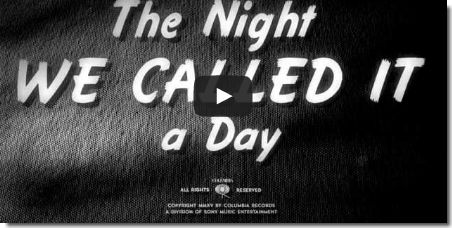
Directed by Nash Edgerton, below is the video for “The Night We Called It a Day,” as sung by Bob Dylan. It is a noirish vignette, pregnant with ambiguity. And kind of fun in its way.

It’s darned cold, at least around these parts, and it’s been cold for far too long. The following song and video should warm, if nothing else, the cockles of one’s heart.
Who else is gonna rescue me
When I’m face down in the snow?
No other dog looks so much like me
And can fill in when I’m ill and unable to make the show
There’s a flask around his neck
Of brandy for me
To sip on as I reflect
On immortality
That’s Ron Sexsmith, from his forthcoming album Carousel One.

Many of the remarks Dylan made in his MusiCares speech a week ago are still echoing around the solar system, upsetting some as much as they’ve been entertaining and/or fascinating others. He covered a lot of ground and he named names, not always in a complimentary fashion. He said himself at the end of the speech: “I probably left out a lot of people and said too much about some.” That was a pretty good bet. So, obviously in the spirit of smoothing some, er, misimpressions, Dylan talked to writer Bill Flanagan, who has always been a worthy interviewer of Bob. Their conversation is posted at BobDylan.com and you can read it yourself. He also expands on some subjects he brought up, like the blues, rock & roll and all that jazz. Continue reading “Bob Dylan Talks (Post-Speech Hoopla) to Bill Flanagan”


In his speech last Friday night, accepting the “Person of the Year” award from MusiCares, Bob Dylan remembered many old gratitudes, for such as John Hammond, the Staple Singers, Joan Baez, Lou Levy, Johnny Cash, and others, and then he also used the occasion to take issue with many of the tropes that music critics have employed when writing about him. And he also took a couple of knocks at some individuals in the music business who he believes disdained his songs many years ago, contrasting those individuals with others who said nice things about his music. People have been reacting different ways to his speech, some focusing on the gratitudes, some focusing on the knocks, some seeing a lot of humor in it all, and some hitting back at Dylan for being petty or cranky. I think one issue is that people have been reading the speech (full transcript here) and of-course Bob wrote it to be delivered—which is a different kind of writing—and there are laugh lines and so forth which temper the crankiness quite a bit. I haven’t seen much video of the speech as yet, but for some reason this Belgian website has a fairly good series of short clips spliced together that do go a long way towards conveying the tone of the delivery. Bob was having a good time. Continue reading “Reactions to Bob Dylan’s MusiCares Speech; Plus The Blackwood Brothers Quartet”
[UPDATE: Full transcript via Randall Roberts of the LA TIMES at this link.]
These are good times. Or maybe the world’s about to end. Or both. Bob Dylan puts out this beautifully recorded, wonderfully executed (my own self-indulgent review to come shortly) album called Shadows In The Night, a tribute to Sinatra but more than that a great work in itself, and now this: Last night Bob Dylan gave a speech well over thirty minutes long when accepting his “Person of the Year” award from MusiCares (a charity for musicians suffering hard times). Dylan, unfiltered by any interviewer or editor, giving his gratitudes and picking some bones along the way.
Except that no one at this point seems to have a full transcript, let alone a tape (though the whole event was recorded for later use). However, significant extracts of Dylan’s speech are quoted here, here and here. Sharp, funny, utterly direct, great stuff.
He picked the perfect moment, didn’t he? That’s what usually happens at charity galas: everyone sits around, has dinner, and then there’s a big speech. Except usually it’s not preceded by a two-hour concert. One may recall if one is old enough how Frank Sinatra was awarded some special mega-Grammy award very late in his life. He was introduced by Bono, who got to make a big speech. Then Frank came on and said “thank you” and was continuing, but was abruptly interrupted. The lights went down and the camera went away. They weren’t expecting a speech; he was supposed to just take the award and go. Maybe he wasn’t in great shape to give a speech—I really don’t know. But no one was going to get away with interrupting Bob Dylan last night.
Good times.
…
Addendum: And if you read the full transcript (now available) you might possibly note like I did that the climax of the speech on paper, i.e. the end of the main speech where Bob is basically talking about himself and his career and his critics, is this section:
The Blackwood Bros. have been talking to me about making a record together. That might confound expectations, but it shouldn’t. Of course it would be a gospel album. I don’t think it would be anything out of the ordinary for me. Not a bit. One of the songs I’m thinking about singing is “Stand By Me” by the Blackwood Brothers. Not “Stand By Me” the pop song. No. The real “Stand By Me.”
The real one goes like this:
When the storm of life is raging / Stand by me / When the storm of life is raging / Stand by me / When the world is tossing me / Like a ship upon the sea / Thou who rulest wind and water / Stand by me
In the midst of tribulation / Stand by me / In the midst of tribulation / Stand by me / When the hosts of hell assail / And my strength begins to fail / Thou who never lost a battle / Stand by me
In the midst of faults and failures / Stand by me / In the midst of faults and failures / Stand by me / When I do the best I can / And my friends don’t understand / Thou who knowest all about me / Stand by me
That’s the song. I like it better than the pop song. If I record one by that name, that’s going to be the one. I’m also thinking of recording a song, not on that album, though: “Oh Lord, Please Don’t Let Me Be Misunderstood.”Anyway, why me, Lord. What did I do?
So that’s how he chose to end, essentially, and what he’s saying there seems clear enough, and also an echo of that quite obscure song once sung by Frank Sinatra that he chose to “uncover” on his latest album, namely, “Stay With Me.”
He then closed by appropriately thanking MusiCares for their work in helping hard pressed musicians, in particular singling out his friend Billy Lee Riley, and then he said “goodbye” this way:
Like the spiritual song, I’m still just crossing over Jordan too. Let’s hope we meet again. Sometime. And we will, if, like Hank Williams said, “the good Lord’s willing and the creek don’t rise.”


Dogs, we’ve often been told, are descended from wolves—or perhaps they’re more like cousins, from a common ancestor, depending on who you talk to. Whatever the case, sheep have little confusion over the issue: they recognize dogs as predators. It seems to be hardwired into the sheep’s nature. If you’re a sheep, when a dog starts approaching, you move in the other direction. This fact of life and nature is used to great effect by trained sheep dogs, who by varying their approach, gait and posture can get groups of sheep to do just about anything. Continue reading “The Wolf Shall Dwell with the Lamb”
 The news lately has been full of scandalous details that have emerged via a cyber attack on the Sony corporation, widely suspected to have been executed by North Korean hackers working to punish the company for producing a comedic film about that country’s leader, the cherubic-faced tyrant and mass murderer Kim Jong-Un (no offense meant, Kim!).
The information made available via this hacking has led to all kinds of guffawing and mockery by media personages and would-be media personages. I have a sense of humor too, and yet I have this sneaking feeling that there’s something seriously out of whack here. Don’t people at these other media entities who are regurgitating and amplifying these stolen communications have any second thoughts about what’s going on? Continue reading “On the Sony Hack and Last Laughs”
 Thanksgiving Day in the U.S.A. has always seemed to me to be very the best holiday, the one where no one is trying to sell you anything at all—except, of-course, for dead, decapitated birds. But even there no hard sell is employed: they’re just laid out in front of you to take your pick. Frozen, fresh, hormone-free, hormone-pumped, antibiotic-free, crack-addicted, gluten-free, glutton-ready; but the big fat carcasses really just sell themselves.
What are the songs of Thanksgiving? Strangely, there are no popular songs which have taken hold. Rewinding through the fraying cassette tape of my brain, I came up with a Loudon Wainright song from the late eighties, simply titled “Thanksgiving.” (There’s a live performance on YouTube at this link.) Now Loudon can often be a laugh-riot, and sharp too, but this is one of his highly mawkish numbers, dwelling on the sadness of meeting the same family members every year and having the same old conflicts, and just getting older, and in essence being unhappy about everything. Continue reading “Thanksgiving”

After the 2012 election, yours truly effectively resigned from commenting on partisan political topics, because … well, for a lot of reasons: getting my prediction dramatically wrong; being depressed by the prospect of the future; and accepting that other kinds of writing are ultimately more enduring (to the extent that anything emanating from this source could possibly be enduring). The world of political punditry and prognostication was greatly shaken by this resignation, naturally, but I’m not sure that anyone else who turned out to be wrong in the prediction business chose to jump off the same cliff. That’s fine; to each his own. Two years later, and with another shift in the political landscape in the U.S., it affords an opportunity to consider whether I made the right decision or not. And I think the answer is that the decision was correct: things turned out after 2012 just as depressingly as expected, with national politics cemented in debilitating trench warfare, and with no progress towards ends that (in all seriousness) I and some like-minded folk consider to be of life and death importance. In fact, there’s only been deterioration with regard to the issues that matter most to me. That’s not a reason to give up taking a stand in the way any normal citizen does, but I guess I continue to feel it is a reason not to let oneself be consumed by the minutiae in the whole depressing fight. There are other things in life, even when the sky is falling. Continue reading “An Election Reflection”
So, the sad news today is that a Dallas hospital worker who had contact with the late Ebola patient Thomas Eric Duncan has now come down with symptoms and been diagnosed with the disease. What should be done? Well, based on the Spanish model, the first thing to do is see if the woman has any pets (in fact she does), and then kill them. This should send a message to all other health care workers who choose to risk dealing with Ebola patients: If you contract it somehow during your work, not only will you have perhaps a 50/50 chance of survival, but your dog/cat/parrot will be euthanized. Continue reading “Texas Hospital Worker Contracts Ebola”
 Doing the rounds on various websites is a clip from a new film titled St. Vincent, starring Bill Murray, directed by Theodore Melfi. The clip is remarkable for how little occurs in it: it’s simply the Bill Murray character singing along to Bob Dylan’s song “Shelter from the Storm” like any ordinary Bob-Dylan-loving-doofus might. Yet it seems to strike some kind of chord with people, given the degree to which it is being circulated. And yours truly has found it oddly charming also. I guess it’s because (a) I can sadly picture myself acting in the same way and (b) Bill Murray is just kind of a likeable bum and (c) It’s so refreshing in these dark times to see someone singing while smoking a cigarette. Continue reading “Bill Murray and “Shelter from the Storm””
 Blues legend and national treasure B.B. King cancelled the remaining eight shows of a concert tour after falling ill on October 3rd in Chicago. King, now 89 years-old, was diagnosed with dehydration and exhaustion. He’s now said to be at home and “feeling better.” Continue reading “B.B. King Cancels Tour Due to Illness”

At enormous expense and after unrestrained effort, working our web development team for many weeks of 14 hour shifts, THE CINCH REVIEW is now being issued in a format more easily readable on your smartphones, tablets, skateboards and other mobile devices. If you are on one of those devices, no action should be necessary: the fact that you are using such a device will be detected by the gigantic antennas and high-magnification cameras we have erected all around the Cinch HQ, and you will automatically be served a page that should require no resizing, with no fidgety sidebars to worry about.
But be careful while reading on your mobile device. THE CINCH REVIEW cannot be held responsible for injuries sustained due to being distracted while mobile …
Sincere wishes for nearness-to-God to all those who have been celebrating holy days this week, both Passover and Holy Week. Unusually, both Christians of the western churches and the eastern Orthodox ones are celebrating Easter simultaneously this year, and aligned with the Jewish Passover. In theory, it should always be like this, but different ways of establishing the religious calendars have intervened. A strange week it’s been, then, of alignments, blood moons, and the like. Continue reading “O Sacred Head, Now Wounded”


