

Yours truly is rarely to be found at the multiplex, but I guess it was spiritually impossible for me not to go see the new Reagan film, given that Bob Dylan recorded a special tune for it (Cole Porter’s “Don’t Fence Me In”). It’s conceivable I would have gone out to see it anyway, but more likely would have waited to check it out some time in the future in the quiet and comfort of home.
All in all, I’m very glad I went. The film is somewhat unconventional and hard to define, but one thing it offers is a review of a key thread of 20th century history that Ronald Reagan was at the center of, however unlikely that might have seemed to many at the time (and to some even now). I think many viewers will also find it to be a reminder, like any such review, of the ways in which history repeats itself, and is in many ways repeating itself right now in America. The underlying and opposing currents remain much the same, though the leading protagonists change. The triumph of one current of history over another at any given juncture is very much linked to the strength of those protagonists. Certainly, this film unabashedly makes the case that Ronald Reagan was an essential man of his era.
The film seats its portrayal of Reagan on four legs: his quiet but profound religious faith; his love of America and its freedom; his remarkably clear-eyed and unwavering view of the danger of communism; and lastly, the very deep and special love between him and Nancy Davis.
Biographers and commentators have long been frustrated by their inability to uncover any deeply hidden thoughts and motivations in Ronald Reagan. He was always, it seems, a what-you-see-is-what-you-get kind of guy: his beliefs were right there on the surface, and he really believed them. For many, this merely added to the reasons to despise him; for others, Reagan’s straightforwardness, clarity and relative lack of guile were together seen as virtue and thus a cause for admiration. It should not be forgotten (and the relevant scenes in this movie remind us) that it was this same directness and dearth of guile on Reagan’s part that led to the breakthroughs with the Soviet leader Mikhail Gorbachev. In their personal meetings, Gorbachev simply couldn’t doubt that Reagan meant what he said, both in terms of his willingness to outspend and overmatch the Soviets militarily, and (conversely) in terms of his openness to peace and nuclear arms reduction.
To my eyes at least, Dennis Quaid looks rather weird in whatever make-up and such was applied to help him resemble Reagan. This can be somewhat shrugged off given that Reagan himself had a funny kind of semi-artificial look to him; he always looked very Hollywood, unsurprisingly enough. But I do think Quaid succeeds in getting under Reagan’s skin and evoking, albeit subtly, the waters beneath that carried him through life.
The movie is extremely ambitious in that it tries to tell—at least glancingly—Reagan’s whole life story, including childhood, young adulthood, movie career, leadership in the Screen Actors’ Guild, early political life, governorship of California, and then presidential candidacy and presidency. This entails a lot of cut-up chronology and flashbacks, and also involves real historical footage spliced in (sometimes in the same frame as the actors). Does it all succeed? Well, I think purely as a film it’s unwieldy and imperfect, but to an audience open to the story, it brings it all home in the end. Indeed, in the theater where I watched, people applauded not once but twice: first, at the end of the movie proper, and then again after the last notes of Bob Dylan’s “Don’t Fence Me In” faded away, along with the slideshow of actual photos of Ronnie and such that make up the long outro.
Whatever its flaws, I found myself unexpectedly a bit choked up on a number of occasions, and delivering real tears at the end (which I won’t spoil by describing here).
I have to admit that I am myself, to some extent, still trying to understand why this onscreen review of Reagan’s life and associated history had that kind of effect on me. When Reagan was in office in the 1980s, I was just a kid and then a teenager, living on the other side of the Atlantic in dear old Ireland. I’m aware, of-course, that Reagan was despised and mocked in the U.S. in the usual quarters (i.e. by everyone but the voters), but, the way I recollect it, it had to have been worse in the European milieu. The first strike against him, after all, was simply that he was an American. And he was so shamelessly American that the obvious thing was to caricature him as an uncultured, unnuanced, simple-minded wannabe cowboy who was going to start World War III. Being an ignorant young idiot reflexively adhering to many of the fashionable leftist poisons of the time, I happily went along with the mockery. Even when the Berlin wall came down ten months after he left the White House, followed shortly by the whole “evil empire” that Reagan had dedicated himself to defeating, I didn’t directly link it to Reagan’s stances and actions in office. It took growing up a little bit more, seeing how the world really worked, and beginning to count through the lies and unlearn some of the comfortable garbage I’d taken for truth.
So I think the source of the tears for me (and I would speculate for others in the audience) was the very best source you can have: that is, gratitude. I’m grateful that Ron stood up on all those occasions when it mattered, in his early life and finally in the Oval Office, when some of us lacked either the insight or the spine or both. I’m grateful he took the slings and arrows from both the malignant and those (like me) too dumb to know better, and that he stayed true. He did not create Heaven on Earth with his presidency (nor ever will anyone) but through his clarity and courage he destroyed one particular kind of Hell on Earth, breaking the Iron Curtain, and enabling at least a chance at freedom for hundreds of millions of people. He lifted America and the world out of the rut of the Cold War which had lasted for over four decades, and which some entrenched interests would no doubt have been happy to see continue (just as some have been happy to help revive it).
He pulled this off with his intelligence, his charm and, in the end, his straight-shooting. Like all the greatest cowboys.
…
The recording Bob Dylan made for the movie did not disappoint. His take on “Don’t Fence Me In” is simultaneously light and poignant, stirred by that special alchemy Bob provides. Add it to the long list of tunes from the Great American Songbook that Dylan has covered (and uncovered) during these golden years of his career.
…
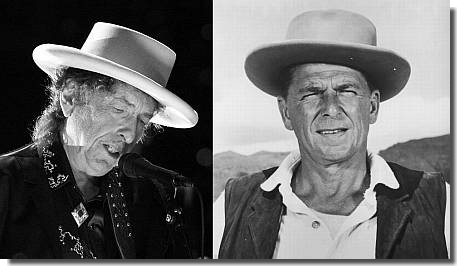
PS: Just found this in the archives. The hat makes the man!


 (Capitol Records, 1957) may well be how a very particular mood is created, quite different to that of the run-of-the-mill Christmas album. It is not so much a mood of lonesomeness (although Sinatra was well-skilled with evocation in that area) but a more nuanced and less inherently-sad sense of simply being alone at Christmas. Not miserable, and not necessarily overjoyed either, but simply contemplating and appreciating the season apart from the crowds and the relatives.
 on Reprise in 1968 (predictably kind of cheesy). And these Christmas tracks get repackaged and resold over and over again. However, A Jolly Christmas is, to my mind, quite distinct. In 1957 when he went in to record it (during July in Los Angeles), Sinatra was truly at the peak of his artistic powers. Not only was his vocal ability (both the quality of his voice and his sense of how to use it) the best it had ever been or would ever be, but he was also at a peak of good taste. My theory is that Sinatra always personally had good taste, but later in his career he came to believe that his potential audience did not, and he dumbed things down at times in an effort to woo them. At this time, however, in the mid-1950s, Sinatra had a clear idea of what he wanted to do, musically-speaking, and what he was capable of, and he was able to work with arrangers and musicians of great excellence and taste themselves, and together they were able to put out records of a very high standard that in turn reached an appreciative and welcoming audience. All of these factors would never come together simultaneously again, and this is why Sinatra’s albums for Capitol Records in the 1950s stand as his greatest, and indeed as some of the most perfect examples of refined popular music that exist.
 (a sterling Nelson Riddle set) and
  (a masterpiece with Billy May). And released in exactly the same month (September of 1957) was
  , one of Sinatra’s great sets of lovelorn ballads, this one arranged by Gordon Jenkins, who likewise is the arranger for A Jolly Christmas. Jenkins had his strengths and weaknesses as an arranger, but there’s no doubting that his particular style is crucial in making A Jolly Christmas the unique kind of Christmas record that it is.




 Speaking of Reggie Watts (