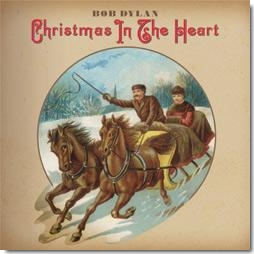
One of the special treats for dedicated Bob Dylan fans this year was the publication of Ray Padgett’s book Pledging My Time: Conversations with Bob Dylan Band Members. It contains 40 interviews with musicians who have played live with Dylan from his earliest days right up to (nearly) the present day.
As detailed there, Randy and the rest of his male quartet for the occasion arrived and participated in a single day of recording, during which they completed “I’ll Be Home For Christmas,” “Here Comes Santa Claus,” “Must Be Santa,” “The First Noel,” and “O Little Town of Bethlehem.” These songs were all recorded live in the studio: everyone all together playing and singing at once. This was enough to blow the singers’ minds, as it is naturally almost never done that way in the modern era, and let alone with such an ensemble. There was Dylan’s regular touring band, a gaggle of special musicians, the four male singers and three unrelated female singers. And in the middle of the room there was Bob Dylan himself, commanding a boombox with various versions of his Christmas favorites for everyone to listen to. Then he’d invite everyone to join in as he launched into one. The singers, accustomed to having arrangements to follow, were flummoxed, but somehow between themselves they worked things out on the fly and came up with parts to sing in appropriate places. (It was something of a Christmas miracle, albeit in Los Angeles in the month of May.)
Hearing that things were this spontaneous surprised me personally, to be honest, because—other than Bob’s own vocals—Christmas in the Heart always sounded pretty slick to me. It certainly succeeds in evoking the classic stylings of many popular old Christmas records. I imagined that more thought and preparation had gone into achieving that. Randy Crenshaw does note that Dylan’s own band was very on the ball and knew what he wanted, so we might presume they had run through some of the material with Bob on previous occasions. But hats off to the backing singers, because they truly delivered performances that sound just right, under quite extraordinary circumstances. (And, true to form, Bob Dylan was disinclined to even listen to the takes; unless there’d been an explosion during the taping, he was happy to move right on to the next tune.)
Back when this album was originally released, I wrote a novella-length review: “Follow the Light: The Heart in Bob Dylan’s Christmas.” The gist of it was my exploration of why this album was the best blending of the secular with the religious songs of Christmas that I’d ever heard. (And I stand by that.) My conclusion as to why that was came down largely to the opening track, Gene Autry’s “Here Comes Santa Claus.” I had never even noticed the religious content in this Santa song before (and indeed, some versions leave it out). Dylan’s version, however, emphasizes it in a way that makes it impossible to miss. His performance ends this way:
Peace on Earth will come to all
If we just follow the light
So fill your hearts with Christmas cheer
’Cos Santa Claus comes tonight
[slower and with emphasis] Peace on Earth will come to all
If we just follow the light Let’s give thanks to the Lord above
’Cos Santa Claus comes tonight
Let’s give thanks to the Lord above
’Cos Santa Claus comes tonight
So, on the opening song of the album, this has the effect of putting Santa in his place. It effectively reorders Christmas, announcing that Santa Claus, the tinsel, the lights, the presents, the reindeer and the rest of that silly, fun stuff are all things that we can and should thank God for. So now, the secular songs of Christmas that follow don’t seem so much to be shoving Jesus out of the way. They are just part of the joy that God gives us, and it’s OK to enjoy them, right alongside hymns like “Hark! The Herald Angels Sing,” and “O Little Town of Bethlehem.” Usually, singers will record either secular or religious Christmas albums, or separate the two in the sequencing of the songs. Bob Dylan, I do believe, blends both in a way that makes them complementary and seemingly of one spirit.
And thanks to Randy Crenshaw’s testimony we now know he did it all live in the studio, by the seat of his pants, with just a break for Subway sandwiches in between.
It truly is a wonderful world. God bless us, every one.
With all that’s going on in the world, it might be argued that not too much notice needs to be taken of the long-anticipated death of a (formerly) alcoholic pop musician at the age of 65. Does it really matter? Well, yes, I think; to the civilized, or what remains of them, everything matters, by definition—at least everything that’s good, for which we rightly give thanks. And, rascal though he was, Shane MacGowan had the gift of a great talent, which he sometimes used very well indeed. In particular, he had the ability and willingness to turn his songwriting voice to subjects most prefer to avoid, or just couldn’t write about, and to characters generally despised, and in so doing to lift them up.
So here are three of what we at Cinch HQ consider to be his greatest songs.
“The Old Main Drag,” from 1985’s peerless Pogues album Rum, Sodomy and the Lash, is, to me at least, the seminal Shane MacGowan song, delivering an unflinching series of vignettes of life on the street in London.
When I first came to London I was only sixteen
With a fiver in my pocket and my ole dancing bag
I went down to the dilly to check out the scene
But I soon ended up upon the old main drag
There the he-males and the she-males paraded in style
And the old men with the money would flash you a smile
In the dark of an alley you would work for a five
For a swift one off the wrist down on the old main drag
It’s safe to say no-one had ever heard a traditional Irish-type tune with lyrics like this. It told you where Shane was coming from, and introduced his unique talent to those who were listening in a brutally brilliant fashion.
The song continues, bereft of redemptive relief, right down to the final verse.
And now I am lying here, I have had too much booze
I’ve been shat on and spat on and raped and abused
I know that I am dying and I wish I could beg
For some money to take me from the old main drag
And there you are left.
…
Not without an element of redemption is the best known and most widely loved song of Shane MacGowan’s, namely “Fairytale of New York,” from the great Pogues album If I Should Fall from Grace with God. The song took a number of years to arrive at its rather miraculous finished state and was released as a Christmas single in 1987, with British songstress Kirsty MacColl singing the feminine half of the duet. It’s no small tribute to Shane’s canniness and taste that he held off on releasing the song until they were able to make exactly the right record of it. And what a record.
The song flashes back and forth in time, painting a picture of a couple who get off the boat from Ireland and are entranced by New York City, at once so large and confounding and yet strangely homey and familiar, and they are there with their big dreams and young love. But whatever gambles they make in life all seem to lose, leading to the middle part of the song in what we might assume is their middle age, if not later:
(She) You’re a bum
You’re a punk (He) You’re an old slut on junk
Lying there almost dead on a drip in that bed (She) You scumbag, you maggot
You cheap lousy faggot
Happy Christmas your arse
I pray God it’s our last
“Fairytale of New York” has become a Yuletide perennial, and those lyrics have caused progressively more fits of conniption from the guardians of political correctness on the airwaves (especially in Britain). It can only be said that anyone who censors the original words is a philistine fit only to be despised to the grave. It is the very honest harshness of these lines that makes the soft sort of reconciliation that creeps in at the end so poignant. It’s not a Christmas song for the super-happy-fun-people: that is for sure. It’s a song for the rest of us losers who still end up believing in something, despite the rocky road we’ve journeyed and the fractured bones we’ve collected on the way.
The boys of the NYPD choir
Still singing Galway Bay
And the bells are ringing out
For Christmas day
It’s impossible to really define what the song is about—this four minute pop tune—and I think it can take you somewhere different every time you hear it. That’s why it doesn’t get old; that and the gorgeous marriage of rhythm and melody that adorn it. Arriving at the point in time that it did, with compact discs coming in, maybe it qualifies as the last truly great and genuine 45 rpm record. (It would get this writer’s vote.)
…
After his fellow Pogues could no longer handle his lifestyle, Shane succeeded in putting out two worthy albums under his own name, accompanied by a combo he called the Popes. The second of these records, The Crock of Gold, features a song titled “St. John of God,” which is the name of a well known mental hospital in the Dublin area. The opening lines are among Shane’s greatest.
See the man, the crushed up man
With a crushed up Carroll’s packet in his hand
Doesn’t seem to see or care or even understand
And all he says is eff yez all
Eff yez all, eff yez all
Carroll’s was (and I guess still is) the quintessential Irish brand of cigarettes. “Eff”, as an expression, might warrant a little explaining to the world in the 21st century. You’d be most likely to encounter it, again, in good Catholic Ireland (at least in my day when I lived there), along with its allied euphemism, “Feck.” It originated not only to spare proper ears from the genuine curse with the “uck” ending, but to avoid the venial sin (necessary to confess to the priest on a Saturday evening) of using an official swear word. So you could say “eff” or “feck” and people knew what you meant, but you hadn’t actually committed the sin. The priests themselves probably emitted more effs and fecks than anyone. It’s a nice racket. (Or was, while it lasted.)
We would assume that this mentally ill man of the street whose portrait Shane paints so pithily has been in fights and suffered unspeakable degradation, and yet something still holds him back from saying that full nasty F word, although he means it, as directed to his persecutors and to the whole world.
And then here he is again, drunk or drugged out of his mind, apparently hugging a statue or a crucifix in a church until the police come to enforce some law or another.
The coppers came
Dragged him away from his crucified Lord
Beat him up in a meat wagon
And they stood him up in court
And all he had to say was
Eff yez all, eff yez all
The defiance of this broken man means nothing, and it means everything. Shane memorializes it. No one else could.
…
Somewhat like the character in that last song, Shane MacGowan did not take very good care of himself, and had less and less to say in his later years. Just about one year ago, Bob Dylan played a concert in Dublin and gave a call out to Shane, invoking the song “Fairytale in New York” and wishing that Shane would make more records. No one who knew Shane’s condition would have thought that very realistic, but then, there’s no harm in asking.
For all that in a perfect world he might have done much more, Shane MacGowan’s greatest songs will not soon be forgotten. His life was a gift, and for it we here give thanks.
This writer’s gratitude for the life of Tony Bennett is directly related to what was his single-minded mission, artistically speaking, and that was to spread the love of the kind of music he loved to sing, that which we call The Great American Songbook; the songs of Irving Berlin, the Gershwins, Jerome Kern, Cole Porter, Rodgers and Hart or Hammerstein, and a great band of others who may not be household names but whose songs have assuredly been heard in almost every house. He could never have dreamed he’d still be doing it with substantial success into his 90s. But on the other hand, being Tony, maybe he did. Looking back, it appears nothing was ever going to stop him except the hand of God Himself.
Being a devoted child of the pop-rock era, it was not until my mid-20s (in the mid-1990s) that I first started listening to Tony’s kind of music. It was easy for types like me to be drawn first to the cool of cats like Frank Sinatra, Dean Martin and Bing Crosby (with the sense of an ounce or two of kitsch in the mix). But listening on that level didn’t get me to comprehend The Songbook. Around that time, Tony Bennett recorded his album Perfectly Frank; it was his take on 24 songs Sinatra had previously recorded, accompanied in this case by just the piano, bass and percussion of the Ralph Sharon Trio. Hearing him sing these tunes differently—and at the same time so well—began to open my mind to the durability and depth of the songs. “One for My Baby” can be sung up-tempo? There was also the blessing of being able to see Bennett sing live around that same time, at New York’s Apollo Theater and at Radio City Music Hall, stages which he certainly could own.
From there, for me, the journey into the music was further advanced by the great Verve songbook albums, with singers from Ella Fitzgerald to Blossom Dearie to Mel Tormé delivering their varied takes on the works of particular songsmiths. I was hooked, and completely absorbed into that music to the exclusion of any other for quite some time. There was so much to find and explore. It was exhilarating.
It was not long after that last one that Columbia Records decided Tony wasn’t making it happen enough in terms of record sales in the era of free love, and pressured him to record more contemporary material. Probably everyone has heard the story of how, after being compelled to record some Beatles tunes, he left the studio and vomited. Everyone knows it because Tony himself told the story. He got away (ultimately) with saying the sainted Lennon and McCartney were only good as emetics because of his total dedication to his own standard of taste. He just stuck with it. He left Columbia and had his kind of wilderness years in the 1970s and 80s, and then, with the canny marketing help of his son Danny and just his own continued devotion to the music he loved, he made it all happen again and became the toast of the MTV generation. In doing so, he truly became an irresistible ambassador for that music.
My own favorite album of his (originally two LPs) was actually recorded during those wilderness years, on the Improv label. It’s Tony Bennett Sings the Rodgers & Hart Songbook, which I’ve written about previously. With the unusual backing of the Ruby Braff (on trumpet)/George Barnes (on guitar) Quartet, Tony’s voice comes down just enough—maybe half a notch—so that it floats above the bed of their smart and insouciant accompaniment. The love that Bennett has for the songs fairly overflows from the grooves. It’s unsurpassable stuff.
Tony Bennett was more complex than the smiling image he projected, as covered in David Evanier’s excellent biography of him, All the Things You Are, which I reviewed in this space. Yet he’ll be remembered most for his simple and undying love for that timeless Great American Songbook, and his indefatigable application of the gifts God gave him to spread the joy he found in it to others, all over the world.
Who says there’s any such thing as settled science? And it’s where science and art meet that we find ourselves, in a collision of controversies where we may ultimately prove that no fact is ever too old to be upended.
In other words, I came across, in a local thrift store, a monophonic LP edition of Frank Sinatra’s Come Swing with Me—as opposed to the stereophonic version I was familiar with—and reality will never be the same. The album is one from Sinatra’s golden era at Capitol Records; it’s arranged and conducted by Billy May, and was released in 1961. Sinatra never put out mere random collections of songs, least of all at Capitol Records, where he effectively invented the notion of concept records, beginning with Songs for Young Lovers in 1954. Come Swing with Me, then, has a marked approach. It is self-evidently a swinging record, with a positive and energetic mood, featuring a lot of songs that Frank had recorded in his younger days with Columbia Records, now given the full treatment with his more mature, aged-in-a-whiskey-cask voice. Billy May also supplies instrumentation and arrangements that are quite novel and distinctive. There are no strings on the album; there is only brass and rhythm, and a LOT of brass: eight trumpets, four French horns, tuba, six trombones, and two bass trombones.
According to Will Friedwald in his authoritative Sinatra! The Song is You, Frank had heard and liked Billy May’s Big Fat Brass instrumental album, and it was his idea to take a similar approach with Come Swing with Me. (Friedwald also notes that May, being overstretched by other projects, actually called on fellow musician/arranger Heinie Beau to write seven of the twelve charts, albeit in the Billy May style. He assuredly succeeded because there’s no telling the difference.)
Another novel aspect was the rather dramatic use of stereo separation. So, there is something of a call and answer effect, with some horn sections or subsections coming entirely from the left speaker and some entirely from the right. The intention was … well, I assume it was to create for the listener a sense of being front and center of a stage where the musicians were performing, some to the left and some to the right. It adds dynamism, as they say. But here’s the thing: for yours truly, it has always been kind of annoying. Although I can recognize that Come Swing with Me is a unique album, with great material, peerless singing and witty, vivacious arrangements, I just have not listened to it nearly as often as the comparable Come Dance with Me or Come with Fly with Me albums. The bleating of some horns from the left and the blaring of others from the right has always struck me as a distraction, and the album just sounded kind of harsh to my ears (which is not a word that comes easily to me when characterizing any Frank Sinatra recording). And to be clear, what I’m describing is the experience of listening to the regular old CD edition of the album, on a fairly regular stereo system; so, not any hi-falutin’ hi-fi room, and not any esoteric remastering of the album—your mileage may vary in those respects.
Back to the thrift store: Vinyl records are usually 50 cents at this place, but they had a half-price sale, so it was a quarter per platter. Someone had recently donated a raft of Sinatra LPs, in relatively rough condition, but at 25 cents each, it was hard to turn down any of them. I mean, you never know. And the truth of that maxim has never been more soundly vindicated.
I believe it wasn’t until I was back home that I noticed the Come Swing with Me LP was a mono edition. You can tell with these old album covers when they write “High Fidelity” and other praise upon it but don’t explicitly say “stereo.” Stereo was something to advertise back then. So, obviously in 1961 they were still pressing records in mono—even when originally recorded in stereo—for the many folks who still had monophonic turntables. (Indeed, in my benighted childhood I was limited to a mono record player even in the 1980s … but please don’t get me started on that.)
So, let’s get to it: I cleaned the dust as best I could from this 60 year-old vinyl record, and put it on. It looked rather worn, but it played well enough, with little noise and no skips. I always find that miraculous, when it occurs with these old records that have clearly not been kept in archival conditions. But more miraculous to my ears was the absence of all that tooting and bleating from one speaker to another. The album just sounded right. Where before there was harshness to my ears, now all was soft and relatively salve-like. Strong and muscular, to be sure, but smooth. In fact, I marveled that had I not known that the album was all brass and no strings, I probably wouldn’t have cottoned on to that fact. It was all arranged and played so well; there was nothing to jar the listener from just enjoying it.
I was taken to such an extent with how wonderful it sounded, compared to the stereo-separated version, that I thought this must have been the original that Frank approved, and later they jiggered it with the new-fangled effects. But history reports this is not so. Sinatra was apparently as excited by the chance to use the stereo in this dramatic way as anyone. It surprises me in particular because I thought Frank was not fond of overbearing or showboating musical distractions from his voice; yet, to me, that’s exactly the ill effect that is achieved by the excessive stereo separation.
Well, what can you say? Can we dig up Sinatra and Billy May and bawl them out? They were human, after all. Actually, I don’t think they’re making humans anymore the way those guys were made, and it’s our loss.
So it seems I’m commending to you, dear reader, something which you may well find impossible to acquire. (You’re welcome.) I don’t know that Come Swing with Me was ever officially issued in CD or any digital format in mono. (With Sinatra it’s a bit hard to keep track of all global releases.) You might find a “vinyl rip” of the mono LP in the dark webs, but of-course we at THE CINCH REVIEW do not advocate lawlessness. Just be assured that if you do come across this mono LP (Capitol W 1594) in your local thrift store, secondhand shop or elsewhere, it’s likely to be well worth the 25 cents to you, and perhaps considerably more.
Frank’s not putting out much new stuff these days. Come Swing with Me, in mono, is unquestionably the best new album I’ve heard all year.
…
For the record, the track list is:
(Side One) Day by Day
Sentimental Journey
Almost Like Being In Love
Five Minutes More
American Beauty Rose
Yes Indeed!
(Side Two) On The Sunny Side of The Street
Don’t Take Your Love From Me
That Old Black Magic
Lover
Paper Doll
I’ve Heard That Song Before
They’re all total winners. Despite the fact that Sinatra at this time was running out his contract with Capitol and extremely eager to move on to his own new label (Reprise), his singing here is pure dynamite. For the ages.
“Shenandoah” is a powerful and mysterious song of America, which people everywhere seem to find moving. I think of it as “of” America both in the sense that it comes from America and in some difficult-to-pin-down fashion it is about America. It is neither a patriotic tune nor an anthem, but it gets at America in a more oblique way; one might compare it to the way in which the song “We’ll Meet Again” conjures thoughts of England, or “Danny Boy” makes people think of the Emerald Isle, or “Myfanwy” evokes Wales. Arguably, like those tunes, it is a national song of heartache.
It’s a song that has long been sung around the world, with many variations. A modern case in point is the rather lovely rendition (embedded via YouTube below) by a Norwegian chanteuse named Sissel.
Sissel’s is not dissimilar to many latter-day versions of “Shenandoah” in that it includes very few words. She sings basically just a few fragments of much longer and older renditions, of the like one still might hear played in folk music circles. It is, in terms of the lyric, very stripped down; there is really no definable narrative at all. Yet, married to that tune, I think most any person of flesh and blood finds it deeply affecting and evocative.
Oh Shenandoah, I long to hear you
Away, you rolling river
Oh Shenandoah, I long to hear you
Away, we’re bound away
’Cross the wide Missouri
Oh Shenandoah, I love your daughter
Away, you rolling river
Oh Shenandoah, I love your daughter
Away, we’re bound away
’Cross the wide Missouri
Oh Shenandoah, I’m bound to leave you
Away, you rolling river
Oh Shenandoah, I’ll not deceive you
Away, we’re bound away
’Cross the wide Missouri
There is of-course much history to the song—enough to fill a couple of fat books. The most basic story is this: The “Shenandoah” of the title (although often taken to be the river in Virginia) was an Iroquois Indian chief, and some of the earliest known lyrics tell a story of a white trader who longed to marry that chief’s daughter but was rejected. The composer is unknown, and as far as anyone seems to be aware it emerged into what was then the popular consciousness as a shanty sung by boatmen and traders voyaging down the Missouri river in the middle of the 19th century. Being traveling types, some of these men ultimately would have carried the song across the Atlantic and beyond.
History and musicology aside, what makes the song so fascinating to me is just how powerfully poignant it is even in its most simplified incarnations; actually, especially in its most simplified incarnations. Why that is must remain ineffable on a certain level, but I have not been able to stop myself wondering about it.
I think that this magical pairing of words and music expresses something fundamental to our human condition that we rarely encounter in song, and rarely enunciate, but inwardly we know to be true. Hearing it shakes us up, albeit in a very good way. There is a sense of mourning in the song, but it is without bitterness. The singer expresses deep longings, but only knows that he (or she) is bound to go, across the mighty river that rolls unceasingly on. Shenandoah himself is being called upon not so much as a person but more like an ancient spirit of the land. There is a deep sense of wonder and submission in the face of the vast spaces and forces that must carry the singer along and inevitably distance him from those he loves.
I would suggest that one doesn’t have to have been voyaging down the Missouri river in the 1850s to have experienced that scenario; rather, it is a very true way of looking at our own lives. After all, we have far less control than we mostly allow ourselves to believe. We come into existence not through any act of our own will. The circumstances into which we are born are beyond our control, and there are countless forces that impact our lives in ways we cannot avoid. We spend our lives striving for autonomy within that which is left to us, losing many we love along the way; finally, nature also carries our own selves away in death. We are specks of dust tossed about in an inconceivably vast landscape. As another songwriter has written: “As for man, his days are like grass / He flourishes like a flower of the field / For the wind passes over it, and it is gone / And its place knows it no more.” (Psalm 103)
The words and music of “Shenandoah” get at that knowledge and that feeling, and at the yearning and unavoidable loss that underlies all human lives, and yet the song does not answer with anger or with hopelessness or with cynicism, but only with a profound sense of awe and of acceptance. Hearing it can, as they say, make strong men cry. It can be quite cathartic and it is, without doubt, absolutely sublime.
* * *
At any rate that’s what I have come to think about the song. Girding up to writing this little thing on it, I’ve listened to many versions. I do believe the power of “Shenandoah” can astound those who sing it. No singer or performer is bigger than this song; they all bow to it in some way. There are, at the time of writing, many stirring and/or interesting renditions on YouTube, and I’ll link below to a few.
…
The good old Robert Shaw Chorale can stand in here for all the countless male voice choirs that have performed “Shenandoah” and continue to do so. (There’s a very tasteful slideshow video in this case; believe it or not, not all on YouTube can be so described.)
…
Paul Robeson receives credit for popularizing the song in the era of recorded music, and his rather glorious rendition is a touchstone.
…
Giving the ladies and the Europeans another look-in, the clip below is a grand concert performance from Slovenia.
…
No one should miss hearing the song in the dulcet baritone of the great Tennessee Ernie Ford, in this clip from his television show where he evokes the sea shanty character of the tune.
(Ernie Ford, by the way, was quite the historian of song. As a case in point, check out his double album of Civil War songs: one platter with the Yankee tunes, and the other featuring the Confederate ones. Just try that today, kids.)
…
The version below by Stuart Foster is titled “Across the Wide Missouri,” and is an example of those that adapt the song into something of a more conventional love ballad. “My lady love, she stands awaitin’ … on the banks, I hear her calling …” Changing the words in this way makes a serviceable love song out of a composition that is otherwise so much more than that. So, in this case, what it loses in the translation is what’s interesting to yours truly.
…
Somewhat in the interest of completeness, we should not forget that there is a movie named Shenandoah, from 1965, directed by Andrew McLaglen. It uses the tune as its theme, but in the context of the river in Virginia and the Civil War. It stars the incomparable Jimmy Stewart and has plenty of other elements on paper that would lead one to think it ought to be a classic, and to many it is; unquestionably, it’s a much-loved film. Yet, I re-watched it recently and have to confess I found it to be a mind-blowing mess. If you want Jimmy Stewart in any kind of western context, my recommendation would be to watch The Far Country, or Bend of the River, or Winchester ’73, all directed by Anthony Mann. Or The Man Who Shot Liberty Valance, by John Ford.
…
If anyone had a voice that could almost still the waves, it was Liam Clancy, and I’d sure want him on my boat to belt out “Shenandoah.” To me, his is one of the essential renditions.
…
And ending with another Irishman (they seem to think the song is theirs), below is a clip featuring the great Van Morrison performing “Shenandoah” with The Chieftains. There is no one who can bring out the transcendent nature of song better than the Belfast Cowboy, and that is not stated lightly.
“We may ignore, but we can nowhere evade, the presence of God. The world is crowded with Him. He walks everywhere incognito.”
– C.S. Lewis, Letters to Malcolm, Chiefly on Prayer
The Swedish pop music quartet known as ABBA—Agnetha, Benny, Björn, Ana-Frid—must be known by just about everyone in the world, and everybody likely has an instant take on them; mainly it’s either “I love them” or “I can’t stand them.” During their career together from 1972 to 1982, they became popular in Britain and Europe well before the USA, and have been in general a lot more popular in Europe. Yours Truly first encountered them as a young transplant from America to Ireland in the mid 1970s, and at 8 or 9 years of age became enraptured by Agnetha on the record sleeve but also by the insanely catchy tunes and alluring recordings.
Of-course—excepting the prodigious among us—no one has discerning taste in music at 8 or 9. Still, I maintain in the face of argument that I have ultimately developed decent musical taste, and have journeyed through various phases of taste and discernment to the present day, discarding some affections while acquiring others. Yet, I never discarded ABBA. Their lack of coolness in many circles never bugged me; I’ve liked (and disliked) the cool and the uncool, and watched many artists journey through stages of coolness and uncoolness, but all that had no influence on how I enjoyed the music. (Truth be told, I’ve enjoyed being perverse that way.) And as time went on I came to realize that in the end what I like is just pop music. Even when listening to debatably-different genres like jazz, folk, punk, country: it’s all just pop music to me, and I’m always on the lookout for that special transition to the sublime that happens when a great pop song, in the right hands, produces chills, tears or unfathomable joy.
For the epitome of a great pop record, I could do no better than to point to the example John Lennon liked to reference: “Be My Baby,” the Phil Spector tune and production, performed by the Ronettes.
While great popular music can obviously get considerably more sophisticated and mature than “Be My Baby,” that track possesses all the essential elements—irresistible tune, great sound and performance, a persuasive pathos and terrific pithiness—and it hits you good and hard with all of that stuff, which makes it such an attractive archetype.
Over their career, ABBA hit the heights, occasionally the depths, and everywhere in-between, but all in all delivered an amazing number of superb tunes that have more than proven their worth by virtue of their longevity in the popular consciousness. I’ve always had a soft spot for their simplest pure pop confections, like “Ring Ring,”“Hasta Manana,” and “Honey, Honey.” Sure, there’s a treacly quality to those early sides, but a little bit of sugar never added to the bitterness in this world.
And a little later in their career, is there a better pop record about a struggling-to-survive marriage than “One Man, One Woman”? Or a more poignant take on watching a child grow up (and grow away) than “Slipping Through My Fingers”?
I’m deliberately avoiding mentioning the biggest hits of all, because everyone knows them so well anyway. Again, the longevity of these songs is amazing, and—by their own account—shocking to the members of ABBA themselves. Something’s going on when so many thousands of contemporaneous hits are all but forgotten, while these continue to be played and discovered anew by millions of listeners. The use of the songs in movies and musicals has been part of that, of-course, but the fact of their usage in those new forms itself attests to their durability. (Personally, I never dug any of that stuff: I continue to just like the original records, though there are one or two cover versions I’ve enjoyed.)
I’d suggest that for a pop artist or group to generate the continuing public affection that ABBA demonstrably have done, there needs to be some inspirational quality in what they do. There needs to be an evocation of something higher, whatever one calls it; there needs to be a stretch towards the sublime. Cynical music (which unfortunately there’s plenty of) doesn’t last, certainly not in the popular consciousness.
In the case of ABBA, I think this inspirational element is their implicit joy in and gratitude for music itself. It’s audible in the records, and it is contagious, and it infects and uplifts the willing listener. It comes across both in the craft of the songwriting and the obvious care and pleasure the artists take in their performances and recordings.
And, conveniently enough, they actually have a song that expresses it directly. That would be “Thank You for the Music.”
Gratitude itself is kind of a holy thing. (From way back.) And expressing gratitude for music is inescapably a “thank you” to the Creator of music. Now, the song has those cute lines wondering who originally “found out that nothing can capture a heart like a melody can,” and then asserting, “well, whoever it was, I’m a fan.” However, although Mr. Gore invented the internet, everyone knows that no politician, industrialist or even any noble peasant invented music. Music is built in to the universe: the music of the spheres, generated from the form and harmony of reality itself. Humans were not needed to create it, but only, perhaps, to hear it. (And make hit records with it.)
I should say that I don’t mean to tread on the religious beliefs or lack thereof of the members of ABBA here. I have no idea what they are, and I’m happy to assume for the sake of argument that all four are securely secular Swedes. That doesn’t matter: a great song is a song which both emerges from somewhere mysterious and continues off to somewhere mysterious. It is not a manifesto of the songwriter’s opinions, because by definition then it would not be a great song. (Not all songwriters know this, to their detriment, but as attested to by their work, Benny and Björn most certainly do.)
When the first new songs to be heard from ABBA in almost forty years were premiered, there were people assembled in various places to enjoy and share the moment. On hearing “I Still Have Faith in You,” and “Don’t Shut Me Down,” many cried, and some compared it to a sacred experience. It might be easy to deride such reactions, but I think what many fans were experiencing did indeed have a sacred element, in that the tears were ones of gratitude. There was a sense of overwhelming gratitude that something extraordinarily unlikely—and quite beautiful—was actually coming to pass.
After all, ABBA were not supposed to get back together and create new music. For decades, it was never seriously contemplated that they would. They’d been there, done that, couldn’t top it, and obviously preferred to leave it as it was. Their breakup was also not merely the run-of-the-mill ending of a musical partnership, but also involved two broken marriages. Reuniting and trusting one another sufficiently to record an album of new songs (some quite personal) cannot but have required an inestimable level of forgiveness.
And one must also consider the unlikeliness of it purely as a matter of physics and biology, if you will. All four are now in their seventies. What are the chances—not merely that all four would still be living—but that all four would be in sufficiently good physical and mental health to make music like they did forty years ago? That part was completely out of their control, and out of everyone’s. There’s a line in “I Still Have Faith in You” about being “humble and grateful to have survived,” and, honestly, no kidding! The tears of gratitude that listeners shed on hearing that song were unavoidably (even if unconsciously) aimed at that Source of things way beyond human power to fashion: things like the very fact of music itself, and of life. When one is crying tears of gratitude for such things, one is not imagining oneself crying into a void, after all. Where there is gratitude, there is a recipient.
The song celebrates faith in one another, and that is surely a wonderful thing, but of-course our faith in one another is not infinite. We are human. We betray, we fight, we divorce; we get sick and we die. Like gratitude, faith also demands a worthy object, and though unnamed and almost surely unintended, that idea envelopes this song.
And it’s a great song: classic ABBA. As is the album as a whole. In addition to being moving, it was really quite funny hearing these new tracks, because it actually sounds as if they’d just gone back into the studio the week after recording their last album and got started again. In their time, their sound was their own but also quite cognizant of contemporary trends. But on this new record they completely ignore the last 40 years of whatever has gone down in the pop music world and are just right back where they left off. (If anything, maybe more 1978 than 1982.)
One of my favorite songs on the album is in fact an outtake from those years that they pulled out and refashioned. That is “Just a Notion,” and hearing it was the impetus for writing this piece in the first place. I felt something strange and remarkable in it and just had to try and put my finger on it. I have no doubt others have heard it too, although I don’t bump into too many ABBA fans round these parts. But, speaking frankly, it was Bob Dylan who helped me hear it. When he recorded his five LPs worth of Great American Songbook/Sinatra tunes, he uncovered (to my ears and mind and those of others) how so many of these great songs of extravagant romantic love can be heard as part of a heavenly dialogue; as a kind of loving conversation with our Maker. I have no idea how Dylan did this, because he didn’t change a single thing about the songs. (He even copied most of the arrangements from Frank’s records.) But do it he did, and quite resoundingly, and in every way those recordings stand as some of the greatest work he has done in his rather otherworldly career. And in doing so, he highlighted how, when even pop songwriters are doing their best work, they cannot but intersect with that higher order of things, and pull down notes from an ineffable melody being played by the most masterful musician of all.
“Just a Notion” is, as Benny has said, a ridiculously happy song. Musically, the recording evokes the aforementioned Phil Spector just a bit for me, as it delivers a pretty decent wall of sound. (I guess the background brass riffs also evoke Spector for me.) It also defies the usual dynamics of a pop record, in that it doesn’t start low and go up, then go back down and go up again, but instead it builds and explodes, then builds more and explodes more, and then builds MORE and explodes MORE. It’s a lot of fun, if you like that kind of thing.
In the song, the singer is apparently possessed by an inexplicable certainty that she is about to meet her dream lover and they are about to embark on their happily-ever-after life. She is exhilarated by this thought and by her sureness about it, and that’s the whole song—just emphasizing over and over again how much faith she has that this encounter will imminently occur.
Just a notion
That you’ll be walking up to me
In a while and you’ll smile and say hello
And we’ll be dancing through the night
Knowing everything from thereon must be right
In real life there’s a thin line between this kind of thinking and terrible tragedy, of-course, but the song brooks none of that. It is 3 1/2 minutes of perfect joy; indeed, it is ecstatic.
And, recalling the lessons from Bob, the thought of ecstasy might suggest another kind of encounter. On that level, I can’t escape the notion that this song expresses the very kind of intense joy that a true believer—someone gifted with a rare and profound faith—might feel when meditating upon the love of God. Think of “His Eye is on the Sparrow,” if you will, or other hymns on the theme. It is the confidence of being secure in the Master’s hand. Even, most blessedly of all, at the very moment of death.
Some may think that a rather macabre idea, but death is the one thing that comes for everybody—much more reliably than a new ABBA album—and wouldn’t it be a consolation if one were able to greet that departure (and arrival) with such a song?
Just so, it would also be wonderful to be able to greet every day of life on earth with such a spirit of hope, faith and joy. Gratitude is due, after all.
Yet one more appreciation of the great Leonard Cohen, this one from yours truly at First Things:
Leonard Cohen was a Canadian, but he was the poet laureate of another nation: a nation of souls by turns sensitive, lost, alienated, ecstatic, bitter—souls seeking truth through the fog of modernity. Cohen was one of those rock-era poets (and arguably the only genuine poet among them) who sounded like he knew something of the utmost importance, even as he spent most of his time sidestepping … (click here for the rest)
It is (in the sense of those things these days) Bob Dylan’s hot new single: “Melancholy Mood.” The song is best known from its recording by Harry James and his Orchestra, with brand new boy singer Frank Sinatra, in 1939. It was the B-side of “From the Bottom of My Heart.” Neither side charted, though both are masterful and lovely records and show the promise of the Sinatra to come. Bob Dylan’s version is embedded below here via YouTube, with a little more on the song and his own quite lovely take on it coming under that.
Comparing Dylan’s to the Harry James/Frank Sinatra side (also on YouTube at the moment) reveals that it is the very same arrangement, as adapted by his five piece guitar-based band. You would think that someone like Dylan would do it as a song, rather than in the style of a big band, where the singer comes in only after the band has gone through the tune already—but you would think wrong. Where Harry James played his trumpet, we have beautiful solo guitar, and on it goes to about the one minute and seven second mark (just as on the James side) and then Bob Dylan steps to the microphone—the most grizzled boy singer you’d ever want to see—and caresses the lyric the rest of the way.
That has been the modus operandi of Dylan on these “Sinatra covers;” that is, to take one of Sinatra’s original recordings (in a lot of cases there were multiple Sinatra versions to pick from) and to simply try to recreate the arrangement with the five piece combo (and occasional extra). In so doing, and in each case, they come up with something beautiful of their own. Dylan’s singing, of-course, is always his own.
And as with his previous interpretations of these old popular songs, Dylan brings resonances to “Melancholy Mood” beyond the boy/girl love theme that would have been the given way of hearing it before. This song, from a lonely soul, even has something to say along those lines, which sounds so right in Dylan’s gentle and aged voice:
But love is a whimsy
And as flimsy as lace
And my arms embrace an empty space
The singer’s soul is “stranded high and dry”—all he can see is “grief and gloom / till the crack of doom.” Still, he prays for release from his melancholy mood, and in Bob’s voice it seems to me this has less the sense of a boy praying for his girl to come back and more the sense of the creature praying to his Creator for an infinitely greater kind of release.
Dylan’s gift to these songs is to show just how deep they can go, without changing a note or a word.
Bob Dylan’s forthcoming album, from which “Melancholy Mood” is taken, is titled Fallen Angels, and is to be released on May 20th. The full track listing is as follows:
1. Young At Heart
2. Maybe You’ll Be There
3. Polka Dots and Moonbeams
4. All The Way
5. Skylark
6. Nevertheless
7. All Or Nothing At All
8. On A Little Street In Singapore
9. It Had To Be You
10. Melancholy Mood
11. That Old Black Magic
12. Come Rain Or Come Shine
And to all that I can only say: Golly! It’s a great time to be alive.
Directed by Frank Sinatra himself, and sponsored by the good people of Bulova and Chesterfield, it’s surely one of the classiest Christmas specials ever to go out over the airwaves: twenty-five minutes of unassuming Yuletide excellence. And it’s currently available via YouTube (and embedded below). Continue reading “Frank Sinatra’s 1957 Christmas Special (with Bing Crosby)”
There’s a communal feeling about most Christmas music. Maybe this is because we generally hear the songs in the company of others, whether it’s as we’re elbowing our way down the aisles of the department store or perhaps singing along with them in church. I think that the most special thing about Frank Sinatra’s A Jolly Christmas (Capitol Records, 1957) may well be how a very particular mood is created, quite different to that of the run-of-the-mill Christmas album. It is not so much a mood of lonesomeness (although Sinatra was well-skilled with evocation in that area) but a more nuanced and less inherently-sad sense of simply being alone at Christmas. Not miserable, and not necessarily overjoyed either, but simply contemplating and appreciating the season apart from the crowds and the relatives.
In the course of his long career Sinatra recorded plenty of Christmas music, from the sides with Axel Stordahl in the 1940s on Columbia (some very lovely stuff) to The Sinatra Family Wish You a Merry Christmas on Reprise in 1968 (predictably kind of cheesy). And these Christmas tracks get repackaged and resold over and over again. However, A Jolly Christmas is, to my mind, quite distinct. In 1957 when he went in to record it (during July in Los Angeles), Sinatra was truly at the peak of his artistic powers. Not only was his vocal ability (both the quality of his voice and his sense of how to use it) the best it had ever been or would ever be, but he was also at a peak of good taste. My theory is that Sinatra always personally had good taste, but later in his career he came to believe that his potential audience did not, and he dumbed things down at times in an effort to woo them. At this time, however, in the mid-1950s, Sinatra had a clear idea of what he wanted to do, musically-speaking, and what he was capable of, and he was able to work with arrangers and musicians of great excellence and taste themselves, and together they were able to put out records of a very high standard that in turn reached an appreciative and welcoming audience. All of these factors would never come together simultaneously again, and this is why Sinatra’s albums for Capitol Records in the 1950s stand as his greatest, and indeed as some of the most perfect examples of refined popular music that exist.
To put it in context, A Jolly Christmas was bookended by A Swingin’ Affair! (a sterling Nelson Riddle set) and Come Fly With Me (a masterpiece with Billy May). And released in exactly the same month (September of 1957) was Where Are You?, one of Sinatra’s great sets of lovelorn ballads, this one arranged by Gordon Jenkins, who likewise is the arranger for A Jolly Christmas. Jenkins had his strengths and weaknesses as an arranger, but there’s no doubting that his particular style is crucial in making A Jolly Christmas the unique kind of Christmas record that it is. Continue reading “A Jolly Christmas from Frank Sinatra”
Frank Sinatra passed away on May 14th, 1998. I recall thinking at the time that with Sinatra gone, all bets were off—anything might now happen in this sad old world. (And I think the record would show that my fears in that respect have been proved entirely correct.) Continue reading “Frank Sinatra’s In the Wee Small Hours“
It would always be a great time to rediscover this wonderful treasure, but it’s especially apt now, in this, Frank Sinatra’s centenary year. On April 17th, 1973, Frank Sinatra performed at the White House, on the occasion of a state dinner in honor of Prime Minister Giulio Andreotti of Italy, with President Nixon, First Lady Pat and assorted dignitaries as his audience. It was a sterling show, and it was recorded, but never officially released. For my part I didn’t even know that a complete film of the evening even existed, although the audio has been released over the years in bootlegged form. (My first encounter with the concert was hearing the great Jonathan Schwartz play some extracts of it on New York’s old WQEW in the early 1990s, when I also happened to be in the first full flush of Sinatra fan-dom.)
Frank Sinatra had famously announced his retirement in March of 1971, so this 1973 show was a special exception to that status … and also turned out to be effectively the end of it. His orchestra on the night was the United States Marine Band, with the great Nelson Riddle conducting (including on some of his own classic arrangements), with Al Viola sitting in on guitar and naturally Bill Miller on piano. Continue reading “Frank Sinatra Sings at the White House (1973 – Complete Film)”
“Send in the Clowns”: It’s an odd song, isn’t it? A bit queer, you could even say. It’s not so easy to get a handle on what it’s about. But undeniably it’s also rather rich, in terms of its musical dynamics and lyrical drama, and I do think that’s why so many singers have been drawn to taking it up and seeing what they can make of it. It’s been sung by everyone from Frank Sinatra to Grace Jones to Roger Whittaker to Van Morrison to … well, maybe that’s quite enough range right there for any song to claim. Continue reading “Frank Sinatra – “Send in the Clowns””
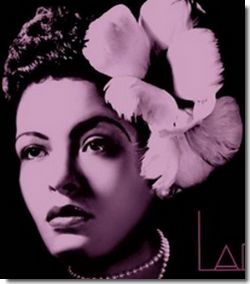
Today’s the centenary of the great Billie Holiday’s birth, on April 7th, 1915. She died far too soon, only 44 years on the earth. Although she packed a good deal of wonderful music into her career, imagine what she’d have accomplished given another couple of decades; with her light, unstrained but supremely articulate way of singing (and given good health) she could have gone on to make masterpieces and electrify audiences well into her old age. Looking back from the perspective of 2015 it seems like hers was one of the first of the celebrated premature deaths of great musical talents that became a long tragic string.
But perhaps that itself is a false perspective; perhaps people have always had this tendency to glamorize the tortured artist or poet who dies too young, too sensitive for this world. Whatever the case, I say screw all that. It’s never a good thing for that talent and that life to come to such an abrupt stop. Imagine Bob Dylan dead in 1966 from the excess and pace of his life then; what a waste to an extent we’d never even have appreciated. Imagine Sinatra in his gloom of 1952, swallowing something lethal or slitting his wrists: what an unspeakable tragedy that we’d never have heard his greatest work still then to come.
None of this is to blame Billie Holiday in the slightest way. She had to fight multiple real demons, and seems hardly to have gotten a break from birth to the grave, from A through Z. What’s amazing is that she managed to record so much great music during the time she had, and stay so true to her talent, and have such a transformational impact on popular singing (most notably on Frank Sinatra, who himself then impacted so many others, and whose centenary is also celebrated this year).
Using that talent, singing as only she could do, surrounded by other hip, gifted musicians, and in her element, she communicated a joy of being alive that soared in spite of the broken world through which she tripped.
“What A Little Moonlight Can Do.” (Below via YouTube, from 1935)
Leonard Cohen is about to release an album of recordings from his most recent concert tours: not so much the hits as the rarities. On it will be his performance of “Choices,” a song that George Jones made his own and made famous. George Jones and Leonard Cohen were both on concert tours in 2013. George Jones was then 81; Cohen was a fresh-faced 78 going on 79. George Jones didn’t quite make it through his tour, falling ill and then passing away on April 26th. His had been intended as a farewell tour, and indeed it was titled “The Grand Tour,” after his classic record of the same name. And Leonard Cohen’s new album is titled Can’t Forget: A Souvenir of the Grand Tour.
I do think that Leonard has been fancying himself quite a bit as a country singer in his latter days, using more and more of those flavors in his songs and performances, and I for one love it. But he would well know that he can’t touch George Jones, and he introduced the song when he sang it live in Germany some weeks after George Jones’ death by saying: “This is in homage to that very great artist.” And indeed it is a very sweet homage. (I think that the official recording—embedded below—is from a soundcheck rather than a concert.)
It is awfully nice to hear the younger folk keeping George Jones’ music alive. But you can’t beat the possum himself, and his version is embedded below, from his rather superb 1999 album, The Cold Hard Truth.
I guess I’m payin’ for the things that I have done
If I could go back, oh, Lord knows I’d run
But I’m still losin’ this game of life I play
Living and dying with the choices I’ve made
If I had to think about it—which I don’t—I guess I would say that Van Morrison is my favorite Irish singer. And if forced to choose—which I’m not—I suppose I’d name Patrick Kavanagh as my favorite Irish poet.
Back when the album Shadows in the Night by Bob Dylan was first announced, in May of 2014, Rolling Stone magazine and others were all labeling it as “Dylan does Sinatra.” Although Frank Sinatra and Bob Dylan have long been the sun and moon in my own musical consciousness (and I’ve always been fascinated by any even-tentative connections between them) I greatly hesitated about jumping on that notion, knowing that a lot of people who don’t know better tend to regard any old popular standards as “Frank Sinatra songs.” We didn’t have a track list. It wasn’t clear what the album was really going to be based upon.
Then we got the track list, and it was immediately obvious to any serious Sinatra aficionado that this album was in fact centered around songs closely associated with Frank; it included songs written for him, songs debuted by him, one cowritten by him, no less than four from a single Sinatra album (1957’s Where Are You?), and most were songs where Sinatra’s rendition is indisputably the one that matters most in musical history. (“That Lucky Old Sun” is an exception, and “Some Enchanted Evening” is assuredly a song that almost everyone has done.) Continue reading “Shadows In The Night: A Sinatra Tribute or NOT a Sinatra Tribute?”
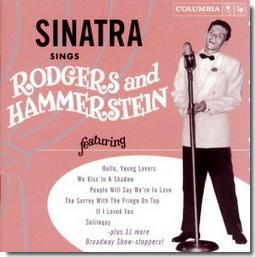
“Some Enchanted Evening,” by Richard Rodgers and Oscar Hammerstein II, is not a song owned by Frank Sinatra, in the sense of him having recorded a version so definitive that others wilt before it. It’s been recorded by way too many singers and sung on far too many stages in productions of South Pacific for that to possibly be true. However, Sinatra recorded it on three separate occasions during his career, qualifying it at least as a special number for him. He recorded it first in 1949 for Columbia Records, when the song was brand new, and was being recorded by a whole clutch of competing singers, as was the way of the music world back then. Sinatra’s version hit number six on the U.S. hit parade, but Perry Como’s got to number one. Sinatra revisited the song in 1963, as part of his “Reprise Musical Repertory Theatre” series, where he and musical cohorts like Dean, Bing, Sammy and Rosemary Clooney got together to record sets from several great musicals, including South Pacific. And then he took it on again for his 1967 album (also on his Reprise label) The World We Knew.
In the context of the musical, the song is a recurring romantic refrain which underlies and lifts the love story between a middle-aged man and a younger woman. Divorced from that, as a popular song, it sounds like gentle advice from someone who has lived and loved and lost and maybe loved again, urging those who are younger to seize that enchanted moment when it arrives and hold on to the love they have found. So, one might assume that the older Sinatra would have pulled it off better. But I don’t think so. I think that Sinatra’s first recording in 1949 on Columbia, arranged by Axel Stordahl, is the best of the three. It’s true that Sinatra was relatively young (34), but because his voice then had a kind of celestial quality, he could pull off a song like this one quite well, as if issuing the profound guidance contained in the words from atop some heavenly cloud. (To me, that’s the same reason his Columbia version of “Hello Young Lovers” works so well, although it seems like the song of a much older man.)
The 1963 rendition (actually two takes: one with Rosemary Clooney and one without) is very enjoyable, with a light, cheerful arrangement, but it hardly distinguishes itself from so many other versions. Sinatra’s 1967 take on the song is adventurous in that it is a swinging and bopping rendition, but to these ears it unfortunately doesn’t quite get where it’s aiming to go.
So it is the simplest arrangement, the purest and most romantic reading of the song, from 1949 on Columbia Records, that this listener at least would recommend most fully.
You might obtain it via iTunes, via Amazon, and you might currently listen to it via YouTube.
Once you have found her, never let her go.
(This post is in honor of Frank Sinatra’s centenary, which we’re marking at the present moment by looking at some of the songs as sung by Frank Sinatra that Bob Dylan selected for his new album Shadows In The Night.)
“Where Are You?” is the title track of the first of the two dark albums that Frank Sinatra recorded during his 1950s’ artistic peak with arranger Gordon Jenkins (the second being 1959’s No One Cares). It’s funny: Sinatra himself was known sometimes to refer laughingly to his loneliness-themed concept records as “suicide albums,” but when he was behind the microphone he was clearly nothing but totally serious about each syllable and every note, and was masterful at constructing these albums with an almost terrifying emotional precision.
All of that would have to start with the selection of songs. “Where Are You?” was a song written by Jimmy McHugh and Harold Adamson in 1937 for the film Top of the Town. It was introduced by Gertrude Niesen (and at the moment you can hear all 78 rpms of her rendition via YouTube).
The song treads riskily on an interesting line (I think) between poignancy and blandness. The lyric is so very straightforward, so plain, so seemingly devoid of device, that its very plainness is its only device. Continue reading “Frank Sinatra – “Where Are You?””
In a career not short on greatness, “Why Try to Change Me Now” is an especially great Frank Sinatra song, and a great Sinatra moment, all the more so as it is actually two moments: two great studio recordings. There are of-course many songs that Sinatra recorded twice (and more) and they’re always very good for providing a window into how he developed as an artist, as this one is. It can also be noticed that the songs he revisited through his career are all great songs. He recorded his share of cheesy or schlocky tunes over the years—a few of which were big hits, indeed—but each of those he recorded just once.
His first recording of this tune was in 1952, and it was his final recording for the Columbia record label.
Sinatra had signed with Columbia in 1942, at the age of 27, after leaving the Tommy Dorsey band, and it was during this era that he came to be known as The Voice, and what a voice it was. Although no longer as purely angelic as on some of those great Tommy Dorsey sides, Frank’s voice wasn’t straying in these years so very far from paradise; it was deeply romantic, and he could conjure with it just the sufficient level of ache when needed. It was the voice that brought out the bobby-soxed girls and made them faint (and worse). But it was a voice anyone could appreciate, with wonderful expressiveness and the remarkable vocal and breath control that Sinatra had worked for years to achieve. It can be heard at its best on the great ballads that Sinatra sang in those Columbia years, like “I Fall in Love Too Easily,” “She’s Funny That Way,” “Try A Little Tenderness,” and “I’m Glad There Is You,” often with the great Axel Stordahl conducting and breaking new ground in the musical framing of a vocalist. Sinatra could swing pretty good too, on tracks like “S’Posin'” and “Five Minutes More,” even if he would find his best shoes for swinging years later with Nelson Riddle and Billy May.
On that final recording date in 1952, the bobby soxers and the acclaim must have seemed to be in the very distant past. His divorce from his first wife, Nancy, and his relationship with actress Ava Gardner had knocked him off any angelic cloud in the popular consciousness, and he’d been struggling as a recording artist and performer. He’d been let go by not only his record company, but also by his movie studio and talent agency. He’d been having real problems with his all-important voice, having difficulty just getting through performances. For his own part, Sinatra maintained that he was glad to get away from Columbia Records: he’d fought for years with producer Mitch Miller over matters of taste, Miller being very fond of novelty records (most infamously represented in Sinatra’s case by the record “Mama Will Bark“) and had to have been dreaming of the freedom to record just what he wanted, just how he wanted. The only problem was that he had no replacement record contract and poor prospects for one. No one on earth could have predicted then how well Sinatra would be doing in just a few short years, following his own muse (albeit ably abetted by other great talents in the studio).
The title of this song, “Why Try to Change Me Now,” seems almost too pat in retrospect as his final turn at the microphone for the record company that he’d felt was trying to change who he was as an artist. But it being Frank Sinatra with a great song in his hands, the record is far, far more than merely a gimmicky goodbye.
The composer, Cy Coleman, noted that Sinatra slightly changed the melody at the opening of the song. He is quoted by Will Friedwald (in the best book I know on Sinatra):
I listened to the record and it sounded so natural, the way that Frank did it, that I thought to myself, “He’s right.” So I left it that way. So I changed the music! That’s the first and only time I’ve ever done that.
The arrangement was by Percy Faith. You can hear the record (or at any rate a digital shadow of it) via iTunes, via Amazon, and currently via YouTube.
The song opens:
I’m sentimental, so I walk in the rain
I’ve got some habits even I can’t explain
Could start for the corner, turn up in Spain
But why try to change me now?
It is in this verse, the next verse and the bridge the song of a misfit, someone who feels himself a bit off-kilter, something of an odd man out in the conventional, modern world. This is not such an unusual theme for a popular song: one could make a very long list of songs with similar sentiments. “Pretty Vacant,” by the Sex Pistols, would be one. “Subterranean Homesick Blues,” by Bob Dylan, would be on that list too. And both are enormous fun in their distinct ways. But the beauty and grace of this take on the theme is just that much more conspicuous when you compare it to such others. There is a restraint in the anguish and alienation that is being expressed with merely a wry shrug (as opposed to a molotov cocktail) and there is no singer better able to distill and express that than Frank Sinatra. His voice is beautiful here, but, knowing where he was at in his life, you can just read the great weariness between the lines.
And then there is the final verse, where the song reveals itself as being addressed in just one all-important direction:
So, let people wonder, let ’em laugh, let ’em frown
You know I’ll love you till the moon’s upside down
Don’t you remember I was always your clown?
Why try to change me now?
It is a plea to someone whose acceptance matters more than all the rest of the world. And Sinatra voices that last questioning couplet with an exquisitely unstrained sense of yearning and of heartbreak. It is inexpressibly masterful.
Envision, if you will, a tragic twist of fate or two, and this might have been the last record Frank Sinatra ever made.
…
But, thank God, it was not. And seven years later, in 1959, Sinatra was standing in front of a microphone to sing “Why Try To Change Me Now” again, this time for his album No One Cares.
In the preceding years, under a new contract to Capitol Records, Frank Sinatra had recorded masterpiece after masterpiece, and along the way defined the potential of the long-playing record in popular music. In the Wee Small Hours, Songs for Swingin’ Lovers, Only the Lonely, Come Fly with Me: these and others can be seen now not merely as great records but irreplaceable cultural treasures. (We’re lucky indeed that millions of copies exist.) Sinatra’s very voice had changed; it had gathered maturity, acquiring some cracks that weren’t there before but with that an even deeper capacity to communicate a song to a listener. Working with brilliant arrangers and musicians, but commanded finally by his own discerning vision, Sinatra recorded some of the most refined, truly adult and simply marvelous popular music that has ever been committed to any medium, before or since.
By this point, he was coming close to the end of this near-perfect run (though he had lots of great stuff still to come). No One Cares was without doubt one of his “mood” albums, the mood succinctly expressed in the title. For these LPs, a crucial element was the way in which Sinatra chose songs without regard to their vintage. There were songs specifically written for the project (like the title track by Sammy Cahn and Jimmy Van Heusen) and others from decades previous (like “I Can’t Get Started,” by Vernon Duke and Ira Gershwin, from 1936). The point was to create a whole that held together, greater even than the sum of its great parts. The arranger in this case was Gordon Jenkins. He is not treated by critics as untouchable to the same degree as fellow arranger Nelson Riddle; he had an approach that could sometimes be considered a bit repetitive or simplistic, featuring what are often described as “high keening strings.” (Riddle, by contrast, was always varied and inventive.) Yet, in these years, Sinatra did not over use Jenkins’ talents. So, the two albums from this period, Where Are You? and No One Cares, stand as great examples of Sinatra’s voice framed by Jenkins’ sparse, emotive and exceedingly dark arrangements. (Ironically enough, Sinatra also called on Jenkins for his marvelous Christmas album.)
While Sinatra, in the second act of his American life, had enjoyed enormous professional success in the middle and late 1950s, he was still a human being, and other aspects had not gone quite as well. His very anguished relationship with Ava Gardner was officially ended with their divorce in 1957.
But from wherever it came, there was never much doubt that great darkness was there under the surface for Frank, and he could tell the truth about it, like no one else, when he was in front of a microphone.
So, his second recorded reading of “Why Try To Change Me Now” is taken significantly more slowly than the first, every note and syllable carefully measured out. It can be heard via iTunes or via Amazon and currently via YouTube.
Frank’s singing still possesses enormous grace and restraint, but the song is performed as if treading on a ledge that is now substantially thinner. Sinatra’s voice has that added depth that maturity has brought and at the same time some added weaknesses, and he puts all of this into play with devastating but still ultimately unstrained effect (and therein lies a crucial element of his genius).
When he reprises, in the end, the final questioning lines of the song …
Don’t you remember I was always your clown?
Why try to change me now?
… his voice conveys an expectation that is different than before. In the Columbia recording, the singer has a love, and he is at least yearning for a positive, accepting answer to his questions. Here—it seems at least to these ears—the words are sung as if to an abyss, to a lover who he wishes would answer him, but one who he knows is no longer listening …
…
(This post is in honor of Frank Sinatra’s centenary, which we’re marking at the present moment by looking at some of the songs as sung by Frank Sinatra that Bob Dylan selected for his new album Shadows In The Night.)
Some of us are date-oriented and some of us are not. By dates, I refer neither to the fruity nor to the romantic kind (though the same statement would probably apply to both) but rather the chronological sort: anniversaries, birthdays, milestones and the like. Some of us are date deniers, wondering whether it matters that such and such happened so many years ago on this date. This day is still little different from yesterday or tomorrow, after all; it’s just another day, significant only for what it achieves for itself, surely, and not its numerical coordination with some other day.
Bob Dylan, however, has apparently been paying some attention to dates. The first track (“Full Moon and Empty Arms”) to be heard from his forthcoming Sinatra-themed album was released to the world last May 13th, the day before the anniversary of Frank Sinatra’s death in 1998 (perhaps someone’s itchy promotional trigger finger caused it to come out a few hours early, at least state-side). And the album itself is being released right here in the first part of 2015 A.D., which happens to be the centenary of Sinatra’s birth (his birth date being December 12th, 1915). Continue reading “Bob Dylan, Frank Sinatra, 2015: A Very Good Year”






 (Capitol Records, 1957) may well be how a very particular mood is created, quite different to that of the run-of-the-mill Christmas album. It is not so much a mood of lonesomeness (although Sinatra was well-skilled with evocation in that area) but a more nuanced and less inherently-sad sense of simply being alone at Christmas. Not miserable, and not necessarily overjoyed either, but simply contemplating and appreciating the season apart from the crowds and the relatives.
 on Reprise in 1968 (predictably kind of cheesy). And these Christmas tracks get repackaged and resold over and over again. However, A Jolly Christmas is, to my mind, quite distinct. In 1957 when he went in to record it (during July in Los Angeles), Sinatra was truly at the peak of his artistic powers. Not only was his vocal ability (both the quality of his voice and his sense of how to use it) the best it had ever been or would ever be, but he was also at a peak of good taste. My theory is that Sinatra always personally had good taste, but later in his career he came to believe that his potential audience did not, and he dumbed things down at times in an effort to woo them. At this time, however, in the mid-1950s, Sinatra had a clear idea of what he wanted to do, musically-speaking, and what he was capable of, and he was able to work with arrangers and musicians of great excellence and taste themselves, and together they were able to put out records of a very high standard that in turn reached an appreciative and welcoming audience. All of these factors would never come together simultaneously again, and this is why Sinatra’s albums for Capitol Records in the 1950s stand as his greatest, and indeed as some of the most perfect examples of refined popular music that exist.
 (a sterling Nelson Riddle set) and
  (a masterpiece with Billy May). And released in exactly the same month (September of 1957) was
  , one of Sinatra’s great sets of lovelorn ballads, this one arranged by Gordon Jenkins, who likewise is the arranger for A Jolly Christmas. Jenkins had his strengths and weaknesses as an arranger, but there’s no doubting that his particular style is crucial in making A Jolly Christmas the unique kind of Christmas record that it is.