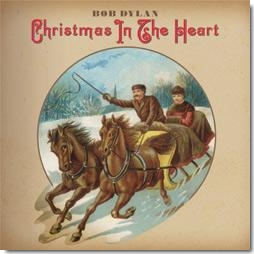
One of the special treats for dedicated Bob Dylan fans this year was the publication of Ray Padgett’s book Pledging My Time: Conversations with Bob Dylan Band Members. It contains 40 interviews with musicians who have played live with Dylan from his earliest days right up to (nearly) the present day.
As detailed there, Randy and the rest of his male quartet for the occasion arrived and participated in a single day of recording, during which they completed “I’ll Be Home For Christmas,” “Here Comes Santa Claus,” “Must Be Santa,” “The First Noel,” and “O Little Town of Bethlehem.” These songs were all recorded live in the studio: everyone all together playing and singing at once. This was enough to blow the singers’ minds, as it is naturally almost never done that way in the modern era, and let alone with such an ensemble. There was Dylan’s regular touring band, a gaggle of special musicians, the four male singers and three unrelated female singers. And in the middle of the room there was Bob Dylan himself, commanding a boombox with various versions of his Christmas favorites for everyone to listen to. Then he’d invite everyone to join in as he launched into one. The singers, accustomed to having arrangements to follow, were flummoxed, but somehow between themselves they worked things out on the fly and came up with parts to sing in appropriate places. (It was something of a Christmas miracle, albeit in Los Angeles in the month of May.)
Hearing that things were this spontaneous surprised me personally, to be honest, because—other than Bob’s own vocals—Christmas in the Heart always sounded pretty slick to me. It certainly succeeds in evoking the classic stylings of many popular old Christmas records. I imagined that more thought and preparation had gone into achieving that. Randy Crenshaw does note that Dylan’s own band was very on the ball and knew what he wanted, so we might presume they had run through some of the material with Bob on previous occasions. But hats off to the backing singers, because they truly delivered performances that sound just right, under quite extraordinary circumstances. (And, true to form, Bob Dylan was disinclined to even listen to the takes; unless there’d been an explosion during the taping, he was happy to move right on to the next tune.)
Back when this album was originally released, I wrote a novella-length review: “Follow the Light: The Heart in Bob Dylan’s Christmas.” The gist of it was my exploration of why this album was the best blending of the secular with the religious songs of Christmas that I’d ever heard. (And I stand by that.) My conclusion as to why that was came down largely to the opening track, Gene Autry’s “Here Comes Santa Claus.” I had never even noticed the religious content in this Santa song before (and indeed, some versions leave it out). Dylan’s version, however, emphasizes it in a way that makes it impossible to miss. His performance ends this way:
Peace on Earth will come to all
If we just follow the light
So fill your hearts with Christmas cheer
’Cos Santa Claus comes tonight
[slower and with emphasis] Peace on Earth will come to all
If we just follow the light Let’s give thanks to the Lord above
’Cos Santa Claus comes tonight
Let’s give thanks to the Lord above
’Cos Santa Claus comes tonight
So, on the opening song of the album, this has the effect of putting Santa in his place. It effectively reorders Christmas, announcing that Santa Claus, the tinsel, the lights, the presents, the reindeer and the rest of that silly, fun stuff are all things that we can and should thank God for. So now, the secular songs of Christmas that follow don’t seem so much to be shoving Jesus out of the way. They are just part of the joy that God gives us, and it’s OK to enjoy them, right alongside hymns like “Hark! The Herald Angels Sing,” and “O Little Town of Bethlehem.” Usually, singers will record either secular or religious Christmas albums, or separate the two in the sequencing of the songs. Bob Dylan, I do believe, blends both in a way that makes them complementary and seemingly of one spirit.
And thanks to Randy Crenshaw’s testimony we now know he did it all live in the studio, by the seat of his pants, with just a break for Subway sandwiches in between.
It truly is a wonderful world. God bless us, every one.
With all that’s going on in the world, it might be argued that not too much notice needs to be taken of the long-anticipated death of a (formerly) alcoholic pop musician at the age of 65. Does it really matter? Well, yes, I think; to the civilized, or what remains of them, everything matters, by definition—at least everything that’s good, for which we rightly give thanks. And, rascal though he was, Shane MacGowan had the gift of a great talent, which he sometimes used very well indeed. In particular, he had the ability and willingness to turn his songwriting voice to subjects most prefer to avoid, or just couldn’t write about, and to characters generally despised, and in so doing to lift them up.
So here are three of what we at Cinch HQ consider to be his greatest songs.
“The Old Main Drag,” from 1985’s peerless Pogues album Rum, Sodomy and the Lash, is, to me at least, the seminal Shane MacGowan song, delivering an unflinching series of vignettes of life on the street in London.
When I first came to London I was only sixteen
With a fiver in my pocket and my ole dancing bag
I went down to the dilly to check out the scene
But I soon ended up upon the old main drag
There the he-males and the she-males paraded in style
And the old men with the money would flash you a smile
In the dark of an alley you would work for a five
For a swift one off the wrist down on the old main drag
It’s safe to say no-one had ever heard a traditional Irish-type tune with lyrics like this. It told you where Shane was coming from, and introduced his unique talent to those who were listening in a brutally brilliant fashion.
The song continues, bereft of redemptive relief, right down to the final verse.
And now I am lying here, I have had too much booze
I’ve been shat on and spat on and raped and abused
I know that I am dying and I wish I could beg
For some money to take me from the old main drag
And there you are left.
…
Not without an element of redemption is the best known and most widely loved song of Shane MacGowan’s, namely “Fairytale of New York,” from the great Pogues album If I Should Fall from Grace with God. The song took a number of years to arrive at its rather miraculous finished state and was released as a Christmas single in 1987, with British songstress Kirsty MacColl singing the feminine half of the duet. It’s no small tribute to Shane’s canniness and taste that he held off on releasing the song until they were able to make exactly the right record of it. And what a record.
The song flashes back and forth in time, painting a picture of a couple who get off the boat from Ireland and are entranced by New York City, at once so large and confounding and yet strangely homey and familiar, and they are there with their big dreams and young love. But whatever gambles they make in life all seem to lose, leading to the middle part of the song in what we might assume is their middle age, if not later:
(She) You’re a bum
You’re a punk (He) You’re an old slut on junk
Lying there almost dead on a drip in that bed (She) You scumbag, you maggot
You cheap lousy faggot
Happy Christmas your arse
I pray God it’s our last
“Fairytale of New York” has become a Yuletide perennial, and those lyrics have caused progressively more fits of conniption from the guardians of political correctness on the airwaves (especially in Britain). It can only be said that anyone who censors the original words is a philistine fit only to be despised to the grave. It is the very honest harshness of these lines that makes the soft sort of reconciliation that creeps in at the end so poignant. It’s not a Christmas song for the super-happy-fun-people: that is for sure. It’s a song for the rest of us losers who still end up believing in something, despite the rocky road we’ve journeyed and the fractured bones we’ve collected on the way.
The boys of the NYPD choir
Still singing Galway Bay
And the bells are ringing out
For Christmas day
It’s impossible to really define what the song is about—this four minute pop tune—and I think it can take you somewhere different every time you hear it. That’s why it doesn’t get old; that and the gorgeous marriage of rhythm and melody that adorn it. Arriving at the point in time that it did, with compact discs coming in, maybe it qualifies as the last truly great and genuine 45 rpm record. (It would get this writer’s vote.)
…
After his fellow Pogues could no longer handle his lifestyle, Shane succeeded in putting out two worthy albums under his own name, accompanied by a combo he called the Popes. The second of these records, The Crock of Gold, features a song titled “St. John of God,” which is the name of a well known mental hospital in the Dublin area. The opening lines are among Shane’s greatest.
See the man, the crushed up man
With a crushed up Carroll’s packet in his hand
Doesn’t seem to see or care or even understand
And all he says is eff yez all
Eff yez all, eff yez all
Carroll’s was (and I guess still is) the quintessential Irish brand of cigarettes. “Eff”, as an expression, might warrant a little explaining to the world in the 21st century. You’d be most likely to encounter it, again, in good Catholic Ireland (at least in my day when I lived there), along with its allied euphemism, “Feck.” It originated not only to spare proper ears from the genuine curse with the “uck” ending, but to avoid the venial sin (necessary to confess to the priest on a Saturday evening) of using an official swear word. So you could say “eff” or “feck” and people knew what you meant, but you hadn’t actually committed the sin. The priests themselves probably emitted more effs and fecks than anyone. It’s a nice racket. (Or was, while it lasted.)
We would assume that this mentally ill man of the street whose portrait Shane paints so pithily has been in fights and suffered unspeakable degradation, and yet something still holds him back from saying that full nasty F word, although he means it, as directed to his persecutors and to the whole world.
And then here he is again, drunk or drugged out of his mind, apparently hugging a statue or a crucifix in a church until the police come to enforce some law or another.
The coppers came
Dragged him away from his crucified Lord
Beat him up in a meat wagon
And they stood him up in court
And all he had to say was
Eff yez all, eff yez all
The defiance of this broken man means nothing, and it means everything. Shane memorializes it. No one else could.
…
Somewhat like the character in that last song, Shane MacGowan did not take very good care of himself, and had less and less to say in his later years. Just about one year ago, Bob Dylan played a concert in Dublin and gave a call out to Shane, invoking the song “Fairytale in New York” and wishing that Shane would make more records. No one who knew Shane’s condition would have thought that very realistic, but then, there’s no harm in asking.
For all that in a perfect world he might have done much more, Shane MacGowan’s greatest songs will not soon be forgotten. His life was a gift, and for it we here give thanks.
Does the world seem to you, as it does to me, to be more than just a little off-kilter these days? The air is filled with histrionics, people’s heads are bouncing from one extreme to another, there are nagging portents of disaster (every time the latest disaster finishes); there is a sense that the guide rails of life have disintegrated, and violence seems to lurk in every shadow. And those are just the better days, when you can see straight. It has seemed to me for the past several years now that God has had His foot heavily on the gas pedal of history, and most of us are without seatbelts.
We sure could use some steady heads: some calm, understated, competent, and genuinely decent people to look to for their example and leadership. And I don’t mean anybody second rate. These times demand the best.
For some reason this came to my benighted mind when I was watching clips of the actor/dancer/singer Fred Astaire on the Dick Cavett show. I’ll try to explain.
There are multiple clips on YouTube of Fred Astaire being interviewed by Dick Cavett, and also performing some songs. The one I’m embedding below particularly struck me. He’s sitting in the interviewee’s chair beside Cavett, and at the point where this starts, the name of Cole Porter has come up, and—as if spontaneously, but certainly not—Fred sings the Porter song “Miss Otis Regrets,” followed by “Night and Day.” Without getting up from his chair, mind you: without going over to stand near the pianist and the rest of the band (as he does on other occasions). It may be watched and enjoyed in the clip right here, beginning at about the 2:55 mark:
For me, it truly calms the soul to watch and listen as Astaire seems to just off-handedly knock out those tunes with such grace and excellence. To do it without leaving his chair makes it seem spontaneous, but it has to be significantly harder to perform with perfect timing when the musicians are at a distance like that. And that’s the theme with Fred Astaire, throughout his incredible career (the twilight of which he was in here): making very difficult things look effortless. Astaire was known for rehearsing to a punishing degree when it came to his dancing, doing take after take of all those famous routines, so that when the audience finally saw it they saw only perfection: a man floating in poetic rhythm without a hint of strain. He could deal with the aches and pains later. There’s no question he rehearsed his songs too, and he certainly rehearsed for these performances on Cavett’s show. He would not do anything sloppily. But the aim of the rehearsal was to deliver in the end to the audience a little bit of pure magic, a seemingly casual rendition of these timeless tunes by one of the great interpreters of popular song. Famously, those great songwriters like Gershwin and Berlin loved it when Fred Astaire would be the singer to debut one of their songs; they thought he just sang them right, the weak pipes notwithstanding (and not-grandstanding either).
Listen to him being interviewed, too, and the charm and grace is there again, but without a trace of glitz. For a man who had seen so much and knew so much, and could say so much, he is utterly unassuming, even shy, with a kind and generous word for everyone. The jokes are self-effacing ones. He’s a gentleman, but one who makes everyone feel more gentle and at ease. He surely makes an all-but-ideal role model, personifying dedication, excellence, good humor and good will towards his fellow man and woman. If only he were around today, it’s impossible to imagine things would be as bad as they are. Not in a world with Fred Astaire.
So, Q.E.D.—we need to get him back. I don’t know if he should be made president or king, but making him the latter would eliminate a lot of complications. And here’s the thing: We have the technology now. With advanced biotech, AI and those new semiconductors, it can certainly be done (and all with renewable energy, I’d bet). There has to be a hairbrush with some of his DNA on it—though admittedly he didn’t have a lot of actual DNA on his head—kept by someone as a memento. There must be something. This is a project that simply has to be pursued, and I’ll post the GoFundMe link first thing tomorrow morning.
As for Dick Cavett, we don’t need to get him back, because he’s still here (at the time of writing). I don’t count myself as one of the biggest fans of his style, but you have to hand it to him: He was there, he seized his moment, and he got interviews with many of the greats who otherwise did not seem to risk such exposure on the small screen. In part, he must have communicated a certain level of safety and comfort, although once or twice he did get under someone’s skin (just ask Lester Maddox, or, um, Randy Newman). If I’m not mistaken, it’s Cavett himself essentially curating the material on the relevant YouTube channel, so now he gets to revive those glory days and profit anew from them.
In any case, all of the Astaire stuff is well worth watching, because—well, I think that’s been covered.
And, while we await his return, there’s likely enough time to watch all his movies again too. Maybe life ain’t so bad after all.
This writer’s gratitude for the life of Tony Bennett is directly related to what was his single-minded mission, artistically speaking, and that was to spread the love of the kind of music he loved to sing, that which we call The Great American Songbook; the songs of Irving Berlin, the Gershwins, Jerome Kern, Cole Porter, Rodgers and Hart or Hammerstein, and a great band of others who may not be household names but whose songs have assuredly been heard in almost every house. He could never have dreamed he’d still be doing it with substantial success into his 90s. But on the other hand, being Tony, maybe he did. Looking back, it appears nothing was ever going to stop him except the hand of God Himself.
Being a devoted child of the pop-rock era, it was not until my mid-20s (in the mid-1990s) that I first started listening to Tony’s kind of music. It was easy for types like me to be drawn first to the cool of cats like Frank Sinatra, Dean Martin and Bing Crosby (with the sense of an ounce or two of kitsch in the mix). But listening on that level didn’t get me to comprehend The Songbook. Around that time, Tony Bennett recorded his album Perfectly Frank; it was his take on 24 songs Sinatra had previously recorded, accompanied in this case by just the piano, bass and percussion of the Ralph Sharon Trio. Hearing him sing these tunes differently—and at the same time so well—began to open my mind to the durability and depth of the songs. “One for My Baby” can be sung up-tempo? There was also the blessing of being able to see Bennett sing live around that same time, at New York’s Apollo Theater and at Radio City Music Hall, stages which he certainly could own.
From there, for me, the journey into the music was further advanced by the great Verve songbook albums, with singers from Ella Fitzgerald to Blossom Dearie to Mel Tormé delivering their varied takes on the works of particular songsmiths. I was hooked, and completely absorbed into that music to the exclusion of any other for quite some time. There was so much to find and explore. It was exhilarating.
It was not long after that last one that Columbia Records decided Tony wasn’t making it happen enough in terms of record sales in the era of free love, and pressured him to record more contemporary material. Probably everyone has heard the story of how, after being compelled to record some Beatles tunes, he left the studio and vomited. Everyone knows it because Tony himself told the story. He got away (ultimately) with saying the sainted Lennon and McCartney were only good as emetics because of his total dedication to his own standard of taste. He just stuck with it. He left Columbia and had his kind of wilderness years in the 1970s and 80s, and then, with the canny marketing help of his son Danny and just his own continued devotion to the music he loved, he made it all happen again and became the toast of the MTV generation. In doing so, he truly became an irresistible ambassador for that music.
My own favorite album of his (originally two LPs) was actually recorded during those wilderness years, on the Improv label. It’s Tony Bennett Sings the Rodgers & Hart Songbook, which I’ve written about previously. With the unusual backing of the Ruby Braff (on trumpet)/George Barnes (on guitar) Quartet, Tony’s voice comes down just enough—maybe half a notch—so that it floats above the bed of their smart and insouciant accompaniment. The love that Bennett has for the songs fairly overflows from the grooves. It’s unsurpassable stuff.
Tony Bennett was more complex than the smiling image he projected, as covered in David Evanier’s excellent biography of him, All the Things You Are, which I reviewed in this space. Yet he’ll be remembered most for his simple and undying love for that timeless Great American Songbook, and his indefatigable application of the gifts God gave him to spread the joy he found in it to others, all over the world.
It is one of the harshest responses Jesus is ever reported to have delivered to someone seeking his help; indeed, it’s arguably the only occasion recorded in the gospels where he responded to a sincere supplicant in a harsh manner. It is when, in initially rejecting her plea, he seems to compare a Gentile woman to a dog. As the old King James has it:
But he answered and said, It is not meet to take the children’s bread, and to cast it to dogs. (Matthew 15:26)
To call someone a dog is generally understood as intending insult even in today’s super pooch-friendly Western society, but in the Middle East, and 2000 years ago, there could be no mistaking the implication. Them’s fightin’ words. Although, culturally, it wouldn’t have been so unusual for Jews of that time and place to react negatively to Gentiles, the gospels do not otherwise show Jesus comporting himself in this way. (Earlier in the same Gospel of Matthew, Jesus had answered the Roman Centurion’s plea to heal his sick servant without any hesitation.)
But what if there has long been an error or inadequacy in translation from the Greek that puts the episode in a significantly different light?
I am not a credentialed Bible scholar, but fortunately I do not come up with this all by my lonesome. Multiple important Biblical translators going back 500 years have taken the same view, as we’ll see; however, those translations have not become the dominant ones. Doubtless, also, many preachers, struggling to give a sermon on the passage, have looked more closely at the Greek for inspiration and have noted this issue for themselves and their congregants. Personally, however, I’ve never sat in a pew and heard it spoken of from the pulpit, although I’ve heard quite a few sermons on this story over my lifetime. So I think it is something that more people should be aware of, and I’d like to go at it in my own way. (It seems, in any case, that no one can stop me.)
Therefore, let’s get to the specifics. The story in question is recounted both in chapter 15 of the Gospel of Matthew and in chapter 7 of the Gospel of Mark. Jesus had traveled to the region of Tyre and Sidon and was staying in a house there.
22 And behold, a Canaanite woman from that region came out and was crying, “Have mercy on me, O Lord, Son of David; my daughter is severely oppressed by a demon.”23 But he did not answer her a word. And his disciples came and begged him, saying, “Send her away, for she is crying out after us.”24 He answered, “I was sent only to the lost sheep of the house of Israel.”25 But she came and knelt before him, saying, “Lord, help me.”26 And he answered, “It is not right to take the children’s bread and throw it to the dogs.”27 She said, “Yes, Lord, yet even the dogs eat the crumbs that fall from their masters’ table.”28 Then Jesus answered her, “O woman, great is your faith! Be it done for you as you desire.” And her daughter was healed instantly.
In Mark 7, the woman is described as being “a Syrophoenician by birth.” Mark also says of the house where Jesus was staying that Jesus “did not want anyone to know, yet he could not be hidden.” The issue of translation, which relates to that word “dogs,” is common to both gospels.
To look at the Greek, one can these days utilize an interlinear translation. You can find one in a downloadable version for Windows at this link. They also provide PDFs. This is a link to Matthew 15.
You will be able to see there, in Matthew 15:26, that when Jesus speaks the fateful line about not casting the children’s bread to dogs, the word in Greek that he uses is kunariois. This is the diminutive form for dogs, and this passage (and the corresponding one in Mark 7) is the only time in the New Testament in which the diminutive form for dogs is used. Translated literally it means “little dogs;” it’s been suggested that alternative ways of rendering it would be puppies, house dogs, pets, or even, if you want to be cute, doggies.
Well! Does this not change everything? Instead of comparing the woman to a dirty and predacious beast in the street, Jesus is comparing her to a puppy or a little pet. Not exactly a compliment, I guess, but nowhere near the aggressive insult of the former translation. You could even make the case that it contains elements of affection. It also provides the Canaanite woman with her opening, because of-course where would you find these little pet dogs except under the table during meals, hoping for crumbs—and this is exactly what she expresses back to Jesus. Her answer shows her great faith, certainly; but it does not come after such a cruel put-down.
I am not a preacher, but I would speculate that this makes the story much easier to preach on. I’ve never heard anyone come up with a satisfactory answer as to why Jesus spoke so harshly in this instance. It turns out, he didn’t.
So how did this come to be mistranslated in the first place? Well, turns out, it didn’t—in the first place—if by the “first place” we consider the first time the New Testament was translated directly from the Greek text into English (as opposed to previous English renderings from the Latin Vulgate). This great task was accomplished by William Tyndale in 1525. And in translating Matthew 15 and Mark 7, Tyndale renders the word as “whelps,” a synonym for puppies. (I love the edition edited by David Daniell of Tyndale’s work, with modern spelling, a gift from my better half.)
So the first try at it got it right. One of the next major translations of the Bible into English was the Geneva Bible, which first emerged in 1560. In this case you can find it (the 1599 edition) online at Bible Gateway. Here is a link to Matthew 15; scroll down to verse 26 and there you are: whelps is the word, and the same in Mark 7.
So what happened to send it all to the dogs? Well, I’m not sure what happened, but I know when it happened, and that was in 1611. The inestimable treasure that is the King James Bible, repository of so much beautiful language, still read by millions today, and which borrowed much from Tyndale’s earlier work, instead renders the word in Matthew 15:26 and the related verses (including in Mark 7) as just plain ol’ dogs. Why? I can only assume that it is impossible now to know. (Please drop me a line if you are more knowledgeable.) However, the overwhelming dominance of the King James, and its influence on later translations, basically put paid to the poor little puppies.
Still, if that was some kind of sin, there exists something of a story of redemption. The only English translation in anything like popular use today which renders the words in Matthew 15 and Mark 7 as “little dogs” instead of “dogs” is none other than the New King James Version (NKJV), first published in 1982 (and not to be confused with the 21st Century King James Version). As for the Revised Standard, the New Revised Standard, the English Standard, the New American Standard, the New International, and the (Catholic) New American versions: all of these, and more—just dogs.
An honorable mention must be given to Young’s Literal Translation, of 1898, which lives up to its name, translating the Greek literally as “little dogs.”
So far we’ve focused on the Bibles of reformers and Protestants, but our dogged pursuit of the matter cannot leave out the Roman Catholic Church. And I think this is quite interesting. In the fourth century (Saint) Jerome translated the Hebrew and Greek scriptures into Latin. This became the Latin Vulgate, and was the definitive Bible text of the Western church for centuries. How did Jerome handle the issue, translating from Greek to Latin? You can find his Mark 7 at this link. When Jesus speaks, the word is rendered as “canibus,” or dogs; when the woman replies, the word is rendered as “catelli,” or whelps. The same is true for Matthew 15. You could say Jerome split the difference; but, then, there wasn’t really a difference to split, in the Greek. I guess he just liked it that way. Yet it leaves Jesus using the harsher word, and that after all is the key point which has made the story unnecessarily difficult.
The Douay-Rheims was at first a Roman Catholic translation from the Latin Vulgate to English in the 16th century, but apparently it then went through multiple substantial revisions without changing its name. The 1899 American Edition is accessible via Bible Gateway, and it does follow the Vulgate on the question at hand. In Matthew 15, Jesus says dogs, and the woman says whelps.
The American Roman Catholic Confraternity Version (my mother’s old copy having the Imprimatur of Francis Cardinal Spellman in 1961) dispenses entirely with the whelps, and has both Jesus and the woman, in both Mark 7 and Matthew 15, speaking only of dogs. The current Roman Catholic New American Bible, as noted earlier, does the same.
So, why? Why any of it? Well, we can’t go back and ask those long dead translators for their reasoning. We can, however, and more relevantly, wonder why modern and indeed contemporary translators have not corrected the text (outside of the NKJV folks).
What is certainly true with regard to new Bible translations is that the the notion of correction is often relative. One man’s correction is another man’s destruction or vandalism. That has to be one of the main reasons why we have so many competing translations in English these days. Where is the line drawn?
In this case, I submit that the line should be drawn with those poor, long-neglected little dogs, by including them in. I believe it would have the triple advantage of being more accurate, more beautiful and more edifying.
Compare it, for example, to another instance, where a “correction” has been made in most translations, but it arguably does not satisfy the above criteria. (And there are undoubtedly many more such.)
Who—Christian or otherwise—has not heard the phrase, “[i]n my father’s house are many mansions”? This is a line that is referenced in vast swathes of English literature, and frequently invoked to this day, whether in a strictly religious context or simply as a matter of allusion.
From chapter 14 of the Gospel of John, the second verse, the King James Version (and likewise how Tyndale had rendered it):
In my Father’s house are many mansions: if it were not so, I would have told you. I go to prepare a place for you.
It seems to me that what makes these words so very memorable and powerful is exactly the incongruity of having mansions contained within a house. Mansions themselves are very big houses, no? But Jesus is talking about the house of God here, and what He has waiting for us therein. It fires the imagination, and has fueled countless encouraging, eloquent and fortifying sermons over the centuries, as well as innumerable hymns.
But is it actually an accurate rendering of the Greek text, and in particular for modern readers? Harrumph. The modern translators don’t seem to think so. As early as the Revised Standard Version of 1946, it had been changed to rooms. “In my Father’s house are many rooms.” Other translators say “dwelling places.” Phooey! I know it’s the same fundamental point, but it’s been stripped of its poetry, and to what end? What has been gained, versus what has been lost?
And certainly, if that kind of strictness is going to be applied in cases where so much is lost in the name of gaining some supposed superior accuracy, then how much more should it be applied in the case of the little dogs of Matthew 15 and Mark 7, who are neither hurting anyone nor robbing the world of its poetry, but are merely waiting, tails humbly wagging, to receive our crumbs?
* * *
In loving memory of all of those good dogs, both the little and the large.
Billie (2004 – 2018)
UPDATE: I am delighted to have just discovered that one highly exceptional and gifted preacher—namely, the late R.C. Sproul—was well aware of Jesus’s use of the diminutive, i.e. little dogs, and incorporates this into his marvelous and moving sermon on Mark 7:24-30 which is embedded here below. Don’t miss it. (If you’ve never heard R.C. Sproul preach, you are in for a revelatory treat.)
Who says there’s any such thing as settled science? And it’s where science and art meet that we find ourselves, in a collision of controversies where we may ultimately prove that no fact is ever too old to be upended.
In other words, I came across, in a local thrift store, a monophonic LP edition of Frank Sinatra’s Come Swing with Me—as opposed to the stereophonic version I was familiar with—and reality will never be the same. The album is one from Sinatra’s golden era at Capitol Records; it’s arranged and conducted by Billy May, and was released in 1961. Sinatra never put out mere random collections of songs, least of all at Capitol Records, where he effectively invented the notion of concept records, beginning with Songs for Young Lovers in 1954. Come Swing with Me, then, has a marked approach. It is self-evidently a swinging record, with a positive and energetic mood, featuring a lot of songs that Frank had recorded in his younger days with Columbia Records, now given the full treatment with his more mature, aged-in-a-whiskey-cask voice. Billy May also supplies instrumentation and arrangements that are quite novel and distinctive. There are no strings on the album; there is only brass and rhythm, and a LOT of brass: eight trumpets, four French horns, tuba, six trombones, and two bass trombones.
According to Will Friedwald in his authoritative Sinatra! The Song is You, Frank had heard and liked Billy May’s Big Fat Brass instrumental album, and it was his idea to take a similar approach with Come Swing with Me. (Friedwald also notes that May, being overstretched by other projects, actually called on fellow musician/arranger Heinie Beau to write seven of the twelve charts, albeit in the Billy May style. He assuredly succeeded because there’s no telling the difference.)
Another novel aspect was the rather dramatic use of stereo separation. So, there is something of a call and answer effect, with some horn sections or subsections coming entirely from the left speaker and some entirely from the right. The intention was … well, I assume it was to create for the listener a sense of being front and center of a stage where the musicians were performing, some to the left and some to the right. It adds dynamism, as they say. But here’s the thing: for yours truly, it has always been kind of annoying. Although I can recognize that Come Swing with Me is a unique album, with great material, peerless singing and witty, vivacious arrangements, I just have not listened to it nearly as often as the comparable Come Dance with Me or Come with Fly with Me albums. The bleating of some horns from the left and the blaring of others from the right has always struck me as a distraction, and the album just sounded kind of harsh to my ears (which is not a word that comes easily to me when characterizing any Frank Sinatra recording). And to be clear, what I’m describing is the experience of listening to the regular old CD edition of the album, on a fairly regular stereo system; so, not any hi-falutin’ hi-fi room, and not any esoteric remastering of the album—your mileage may vary in those respects.
Back to the thrift store: Vinyl records are usually 50 cents at this place, but they had a half-price sale, so it was a quarter per platter. Someone had recently donated a raft of Sinatra LPs, in relatively rough condition, but at 25 cents each, it was hard to turn down any of them. I mean, you never know. And the truth of that maxim has never been more soundly vindicated.
I believe it wasn’t until I was back home that I noticed the Come Swing with Me LP was a mono edition. You can tell with these old album covers when they write “High Fidelity” and other praise upon it but don’t explicitly say “stereo.” Stereo was something to advertise back then. So, obviously in 1961 they were still pressing records in mono—even when originally recorded in stereo—for the many folks who still had monophonic turntables. (Indeed, in my benighted childhood I was limited to a mono record player even in the 1980s … but please don’t get me started on that.)
So, let’s get to it: I cleaned the dust as best I could from this 60 year-old vinyl record, and put it on. It looked rather worn, but it played well enough, with little noise and no skips. I always find that miraculous, when it occurs with these old records that have clearly not been kept in archival conditions. But more miraculous to my ears was the absence of all that tooting and bleating from one speaker to another. The album just sounded right. Where before there was harshness to my ears, now all was soft and relatively salve-like. Strong and muscular, to be sure, but smooth. In fact, I marveled that had I not known that the album was all brass and no strings, I probably wouldn’t have cottoned on to that fact. It was all arranged and played so well; there was nothing to jar the listener from just enjoying it.
I was taken to such an extent with how wonderful it sounded, compared to the stereo-separated version, that I thought this must have been the original that Frank approved, and later they jiggered it with the new-fangled effects. But history reports this is not so. Sinatra was apparently as excited by the chance to use the stereo in this dramatic way as anyone. It surprises me in particular because I thought Frank was not fond of overbearing or showboating musical distractions from his voice; yet, to me, that’s exactly the ill effect that is achieved by the excessive stereo separation.
Well, what can you say? Can we dig up Sinatra and Billy May and bawl them out? They were human, after all. Actually, I don’t think they’re making humans anymore the way those guys were made, and it’s our loss.
So it seems I’m commending to you, dear reader, something which you may well find impossible to acquire. (You’re welcome.) I don’t know that Come Swing with Me was ever officially issued in CD or any digital format in mono. (With Sinatra it’s a bit hard to keep track of all global releases.) You might find a “vinyl rip” of the mono LP in the dark webs, but of-course we at THE CINCH REVIEW do not advocate lawlessness. Just be assured that if you do come across this mono LP (Capitol W 1594) in your local thrift store, secondhand shop or elsewhere, it’s likely to be well worth the 25 cents to you, and perhaps considerably more.
Frank’s not putting out much new stuff these days. Come Swing with Me, in mono, is unquestionably the best new album I’ve heard all year.
…
For the record, the track list is:
(Side One) Day by Day
Sentimental Journey
Almost Like Being In Love
Five Minutes More
American Beauty Rose
Yes Indeed!
(Side Two) On The Sunny Side of The Street
Don’t Take Your Love From Me
That Old Black Magic
Lover
Paper Doll
I’ve Heard That Song Before
They’re all total winners. Despite the fact that Sinatra at this time was running out his contract with Capitol and extremely eager to move on to his own new label (Reprise), his singing here is pure dynamite. For the ages.
I personally made the above image of the crossed-out robot to symbolize “AI Free Zone,” in order to stick it on my website. It took me days. Shucks, using AI, it probably would have taken mere seconds. But then that would have defeated the purpose. (And try explaining that to a robot.)
For years we’ve been hearing about the steady approach of the age of artificial intelligence. It sounded to me like dystopian sci-fi but I was too busy listening to old Bing Crosby LPs to spend any real time worrying. I bet the same goes for you. Then, whoops, I go look at Twitter and everyone’s talking about ChatGPT, which has come out of the “OpenAI” project (and it turns out that project is not so “open” anymore). In this and other incarnations AI is coming online but fast and it’s a highly commercial proposition. It’s about ready to do your job, supply your news, buy your house and play pretty melodies of its own composition on a banjo while you retire to another realm entirely.
You haven’t heard as much about it as you should have in the mainstream press, but then, by the time you read this, AI itself might be writing all those stories about the Trump indictment and the price of eggs, and supplying evidentiary photos and videos to boot. One of the things we’re going to have get used to most quickly is that AI does not merely have the ability to generate false news (on an unutterably massive scale) but because this ability exists it will be increasingly hard to persuade any critical mass of people (remember them?) of the undeniable truth of any actual news. And you thought it was hard enough already to keep track of which conspiracy theories have come true, which ones will come true in six months, and which ones will take another couple of years to mature. The existence of AI will demand a much larger set of file folders to separate each day’s mis-information, dis-information, mal-information, and that rare but potential actual plain old information. The good news is that AI can print all the necessary labels for you.
Do you want to listen to music composed by AI, or read stories and poetry written by a machine, no matter how seemingly beautiful and compelling? I don’t. I think the very concept has a strong scent of evil about it. Yet, I’m fully anticipating that anyone who thinks like me will very soon be regarded much like a member of some primitive tribe in the wilderness who thinks that having his photo taken steals his soul.
But advanced computerization is not really the problem. It can achieve amazingly good things, like new medicines and more evocative emojis. The problem is to whose service the technology is ultimately devoted. Is it for average Joes? Well, it’s not an auspicious time to be born as an average human being. Populations have been in decline in many societies across the globe, and this extinction syndrome is spreading. Notwithstanding this, humans continue to be under attack at the beginning of their lives, with abortion, and at the later stages, with euthanasia, and increasingly at points in-between, with judgments being made about the worthiness of the lives of people afflicted with any kind of suffering that defies easy cure.
And since multiple generations of schoolchildren have been taught that humans are responsible for world-ending global warming, many self-identifying homo-sapiens are inclined to believe that the universe would be better off without us.
Enter artificial intelligence, which promises to be able to do many of the things that used to be the sole bailiwick of the human animal, and the average Joe and Jill are soon going to be wondering what they’re even here for. They won’t be the only ones wondering. AI becomes the latest tool which the powerful possess to corral the regular folk into being controllable citizens.
Somebody once wrote:
So God created man in his own image,
in the image of God he created him;
male and female he created them. (Genesis 1:27)
That was some pretty good stuff someone came up with, before the computer, before the typewriter, before the ballpoint pen, before paper. That notion of the human being having been made in the image of God has been a touchstone; it has not made this world perfect, but it has been invoked countless times to reverse great injustice and horrible cruelty. Even if you’re an atheist, you need some rationale that asserts a special sanctity to human life, or else everything becomes utilitarian, and people are valued only for what they can do, instead of simply for what they are.
Artificial intelligence is going to test such notions to an extent they’ve never been tested. And it’s screaming into the station at about 200 miles per hour. The only thing the techies seem to agree on is that the engine has no brakes. And they built it!
* * *
But never fear. Anytime you need a goofy little article by a flawed piece of flesh and blood on music, occasionally one about a book or a movie, maybe with a bit of topical commentary, and a good indigestible swirl of half-baked philosophizing, this human will be somewhere in the vicinity of this website writing one (or at least thinking about it).
That is, until my plug gets pulled, by AI, or the real Big Guy—whichever comes first.
“Shenandoah” is a powerful and mysterious song of America, which people everywhere seem to find moving. I think of it as “of” America both in the sense that it comes from America and in some difficult-to-pin-down fashion it is about America. It is neither a patriotic tune nor an anthem, but it gets at America in a more oblique way; one might compare it to the way in which the song “We’ll Meet Again” conjures thoughts of England, or “Danny Boy” makes people think of the Emerald Isle, or “Myfanwy” evokes Wales. Arguably, like those tunes, it is a national song of heartache.
It’s a song that has long been sung around the world, with many variations. A modern case in point is the rather lovely rendition (embedded via YouTube below) by a Norwegian chanteuse named Sissel.
Sissel’s is not dissimilar to many latter-day versions of “Shenandoah” in that it includes very few words. She sings basically just a few fragments of much longer and older renditions, of the like one still might hear played in folk music circles. It is, in terms of the lyric, very stripped down; there is really no definable narrative at all. Yet, married to that tune, I think most any person of flesh and blood finds it deeply affecting and evocative.
Oh Shenandoah, I long to hear you
Away, you rolling river
Oh Shenandoah, I long to hear you
Away, we’re bound away
’Cross the wide Missouri
Oh Shenandoah, I love your daughter
Away, you rolling river
Oh Shenandoah, I love your daughter
Away, we’re bound away
’Cross the wide Missouri
Oh Shenandoah, I’m bound to leave you
Away, you rolling river
Oh Shenandoah, I’ll not deceive you
Away, we’re bound away
’Cross the wide Missouri
There is of-course much history to the song—enough to fill a couple of fat books. The most basic story is this: The “Shenandoah” of the title (although often taken to be the river in Virginia) was an Iroquois Indian chief, and some of the earliest known lyrics tell a story of a white trader who longed to marry that chief’s daughter but was rejected. The composer is unknown, and as far as anyone seems to be aware it emerged into what was then the popular consciousness as a shanty sung by boatmen and traders voyaging down the Missouri river in the middle of the 19th century. Being traveling types, some of these men ultimately would have carried the song across the Atlantic and beyond.
History and musicology aside, what makes the song so fascinating to me is just how powerfully poignant it is even in its most simplified incarnations; actually, especially in its most simplified incarnations. Why that is must remain ineffable on a certain level, but I have not been able to stop myself wondering about it.
I think that this magical pairing of words and music expresses something fundamental to our human condition that we rarely encounter in song, and rarely enunciate, but inwardly we know to be true. Hearing it shakes us up, albeit in a very good way. There is a sense of mourning in the song, but it is without bitterness. The singer expresses deep longings, but only knows that he (or she) is bound to go, across the mighty river that rolls unceasingly on. Shenandoah himself is being called upon not so much as a person but more like an ancient spirit of the land. There is a deep sense of wonder and submission in the face of the vast spaces and forces that must carry the singer along and inevitably distance him from those he loves.
I would suggest that one doesn’t have to have been voyaging down the Missouri river in the 1850s to have experienced that scenario; rather, it is a very true way of looking at our own lives. After all, we have far less control than we mostly allow ourselves to believe. We come into existence not through any act of our own will. The circumstances into which we are born are beyond our control, and there are countless forces that impact our lives in ways we cannot avoid. We spend our lives striving for autonomy within that which is left to us, losing many we love along the way; finally, nature also carries our own selves away in death. We are specks of dust tossed about in an inconceivably vast landscape. As another songwriter has written: “As for man, his days are like grass / He flourishes like a flower of the field / For the wind passes over it, and it is gone / And its place knows it no more.” (Psalm 103)
The words and music of “Shenandoah” get at that knowledge and that feeling, and at the yearning and unavoidable loss that underlies all human lives, and yet the song does not answer with anger or with hopelessness or with cynicism, but only with a profound sense of awe and of acceptance. Hearing it can, as they say, make strong men cry. It can be quite cathartic and it is, without doubt, absolutely sublime.
* * *
At any rate that’s what I have come to think about the song. Girding up to writing this little thing on it, I’ve listened to many versions. I do believe the power of “Shenandoah” can astound those who sing it. No singer or performer is bigger than this song; they all bow to it in some way. There are, at the time of writing, many stirring and/or interesting renditions on YouTube, and I’ll link below to a few.
…
The good old Robert Shaw Chorale can stand in here for all the countless male voice choirs that have performed “Shenandoah” and continue to do so. (There’s a very tasteful slideshow video in this case; believe it or not, not all on YouTube can be so described.)
…
Paul Robeson receives credit for popularizing the song in the era of recorded music, and his rather glorious rendition is a touchstone.
…
Giving the ladies and the Europeans another look-in, the clip below is a grand concert performance from Slovenia.
…
No one should miss hearing the song in the dulcet baritone of the great Tennessee Ernie Ford, in this clip from his television show where he evokes the sea shanty character of the tune.
(Ernie Ford, by the way, was quite the historian of song. As a case in point, check out his double album of Civil War songs: one platter with the Yankee tunes, and the other featuring the Confederate ones. Just try that today, kids.)
…
The version below by Stuart Foster is titled “Across the Wide Missouri,” and is an example of those that adapt the song into something of a more conventional love ballad. “My lady love, she stands awaitin’ … on the banks, I hear her calling …” Changing the words in this way makes a serviceable love song out of a composition that is otherwise so much more than that. So, in this case, what it loses in the translation is what’s interesting to yours truly.
…
Somewhat in the interest of completeness, we should not forget that there is a movie named Shenandoah, from 1965, directed by Andrew McLaglen. It uses the tune as its theme, but in the context of the river in Virginia and the Civil War. It stars the incomparable Jimmy Stewart and has plenty of other elements on paper that would lead one to think it ought to be a classic, and to many it is; unquestionably, it’s a much-loved film. Yet, I re-watched it recently and have to confess I found it to be a mind-blowing mess. If you want Jimmy Stewart in any kind of western context, my recommendation would be to watch The Far Country, or Bend of the River, or Winchester ’73, all directed by Anthony Mann. Or The Man Who Shot Liberty Valance, by John Ford.
…
If anyone had a voice that could almost still the waves, it was Liam Clancy, and I’d sure want him on my boat to belt out “Shenandoah.” To me, his is one of the essential renditions.
…
And ending with another Irishman (they seem to think the song is theirs), below is a clip featuring the great Van Morrison performing “Shenandoah” with The Chieftains. There is no one who can bring out the transcendent nature of song better than the Belfast Cowboy, and that is not stated lightly.
We here offer our best wishes and a sincere prayer for good health to Mark Steyn, the one-of-a-kind writer and commentator, who suffered a couple(!) of heart attacks a couple of weeks ago. He revealed this grim news in his uniquely jaunty/jaundiced fashion during his weekly audio Q&A on his own website, after having been missing for a week from his usual TV gig on Britain’s GBNews.
Steyn has long been like one of the family in the Cinch household, as he no doubt is in quite a few others, so this news arrived as much more than just an ordinary lump of coal.
In particular, although Mrs. C. and I live in the U.S., his weekday show on GBNews had become our sole bit of must-watch television, and just about our only source of TV news and commentary. That’s not just because virtually all U.S. television news is deeply dishonest and vile—though it most certainly is—but also because the news here is so unrelentingly bad that it is effectively unbearable to sit and take it in (no matter how they try to get us to swallow it). The beauty of Steyn’s show, for us, is that the issues he focuses on—although very closely related on a macro level to things going on in the U.S—are at least one step removed from our own daily reality. The players’ names are different, although the games they are playing are essentially the same.
So, we can enjoy Steyn’s side-splitting skewering, day by day, of the likes of Klaus Schwab, Rishi Sunak, and Ursula von der Leyen (or, as he would have it: the sinister Teutonic megalomaniac hiding in plain sight as a sinister Teutonic megalomaniac; Rishi Rich; and Cruella von der Leyen, respectively). He pays little or no attention to the daily ticker of distracting stories tossed up like Milk Bones to mutts by the corporate media, and instead zooms in on the underlying rot, and the players who are pursuing an agenda of civilizational destruction, whether through outright malignancy or abject obliviousness to reality. And he perfectly frames them and their plans as the objects of mockery that they ought to be to any people who value what freedom they still retain.
We need a lot more of that.
Instead, with Mark Steyn no doubt facing a long period of recovery, we will have less of it. Nevertheless, we’ll continue checking in on GBNews, which has proved itself a spunky and worthy media start-up, and one that seems to be moving the needle in the direction of free debate in Great Britain on previously undiscussable topics.
For Mark’s own sake, we hope that he places his health first, even if that means a very long break from the stresses of a near-daily live television show, and indeed even if it should mean a permanent break from such. His voice is one of the most special and irreplaceable out there. Even if he were to break from topical commentary entirely and limit himself to writing about music and such—which he does so very well—we would be much happier continuing to hear that voice, rather than mourning its premature passing.
Above all, here’s to his health and increasing strength.
…
UPDATE: In a bizarre turn of events, the executive leadership of GBNEWS chose to jettison Mark Steyn after his heart attacks, by requiring him to sign a contract no rational person would sign. In essence, they gave in without a fight to the state regulators of speech and thought at Britain’s “Ofcom” agency. Steyn continues to post his inimical content at his own website, so follow him there.
The leak of Samuel Alito’sdraft opinion overturning Roe v. Wade and Planned Parenthood v. Casey has made me think of my father (quite unexpectedly, I might add). This is not because my father served on the U.S. Supreme Court—he didn’t—and neither is it because I ever knew him to leak confidential documents to the press, in order to interfere with a judicial process or for any other reason. It’s rather because of something he said to me during the last year of his life.
For context, I should confess that my father and I were at odds for pretty much the entirety of our overlapping time on Earth. It involved family issues, in the main, and there’s nothing to be gained by going over it. We always maintained a relationship, and I never stopped visiting him and my mother, but it’s hard for me to remember a single day of my life I wasn’t mad at him; that is, until about the final year of his life. He died aged 91 (about six years ago).
I saw him several times during that final year or so (which required flying from the U.S. to Ireland where he and my mother were living together, at that point in a nursing home). I saw that something had changed in him, at that late date, and my inner anger at him melted away. It wasn’t by reasoning or choice: it just happened. For that, I’m deeply and humbly grateful to God. Changes of heart come from God, I happen to believe; I also think they are the most powerful of miracles.
Anyhow, during one of those visits, my father brought up, on his own, the subject of the U.S. Constitution. I don’t recall him ever talking about it before, but, strangely enough, it was on his mind in those final months. He was remembering his swearing of an oath to uphold and defend the Constitution, which he would have done when he joined the National Guard, and again when he received U.S. citizenship, and likely again when he served as a peace officer with the Bridge and Tunnel Authority in New York City. He was recalling this oath, and saying, with a great deal of emotion, “I never would have done it! If they’d told me that abortion was a right in the Constitution, I never would have done it!” He was crying, truth be told.
I attempted to argue that there really wasn’t a right to abortion enumerated in the Constitution: that Roe v. Wade was a poorly reasoned opinion and that there were many who still hoped to see it overturned one day. But he seemed to ignore my words. He was somewhere deep in his own mind, and, besides, he was correct as to the practical reality of the thing. What did it matter what I or anyone else thought about the legal soundness of Roe v. Wade? It had been the unopposable law of the land for over 40 years, helping to facilitate the termination of over one million babies during each of those years. That’s some pretty solid soundness, in the real world.
I guess it’s a good thing I wasn’t angry at him anymore, because if I’d wanted to twist the knife, I might have asked him why he voted for all those Democrat politicians all his life, many of whom had supported the abortion regime. My father was, in his way, a very conservative Irish Catholic, attending mass diligently and certainly expressing his belief in what the Church taught. Going through his papers after his death it was obvious he had contributed to pro-life organizations (and also to charities that helped the poor in Africa). Yet, when he voted, to my knowledge, it was always according to his perception of who would be better for his pocketbook. And he never stopped worrying that the Republicans would cut Social Security. Also, in fairness, in my father’s time in the U.S., things weren’t quite as clear-cut as today. There were still some pro-life Democrats back then. Abortion was definitely an issue, but not quite the Supreme Holy Sacrament of liberalism that it has now (so very weirdly) become.
As Samuel Alito observed in his opinion, neither Roe nor Casey settled anything, in the way that big Supreme Court decisions are traditionally supposed to do. The Supreme Court’s short-circuiting of the democratic process on this issue has twisted the politics of America. The people who were allegedly in the more compassionate wing had to prove their compassion by supporting the easier killing of the most innocent and the most helpless. Politicians have compromised their (ostensibly) most sacred beliefs, and adopted incredible, pretzel-like morality, in order to be seen as being on the correct side of this issue (a case in point being the current occupant of the Oval Office). The U.S. electorate has only become more deeply divided and mistrustful, year by year. And that civic poison is just one of the ways in which the nation has already seen judgment. The absence on the streets of this nation of those tens of millions of human beings who were killed before they could take their first breaths: that is a judgment and indeed a punishment which America will be reckoning with until America is no more.
***
I’m thinking today that my father’s surprising, late anguish at having sworn allegiance to the U.S. Constitution speaks well of him—that he was sensitive and cognizant enough to have that on his mind. Serious things ought to be taken seriously. When the Supreme Court conjured a fundamental right to abort babies out of America’s founding documents, and it was allowed to stand and to override all objections and create the horrifically exploitative abortion industry, on a certain level everyone in America was implicated. It has been a true national sin, albeit that some good people have dedicated themselves since that very day to turn that decision back.
It would have been nice to be able to read Samuel Alito’s opinion to my father, and have him understand that he didn’t swear allegiance to anything evil when he swore to uphold the U.S. Constitution. It’s just that the “upholding” part is heavy work.
We hold that Roe and Casey must be overruled. The Constitution makes no reference to abortion, and no such right is implicitly protected by any constitutional provision, including the one on which defenders of Roe and Casey now chiefly rely—the Due Process Clause of the Fourteenth Amendment. That provision has been held to guarantee some rights that are not mentioned in the Constitution, but any such right must be “deeply rooted in this Nation’s history and tradition,” and “implicit in the concept of ordered liberty.”
At least my father didn’t live to see his beloved Ireland embrace abortion in 2018; it’s the only country, as far as I know, that legalized abortion in a popular referendum, accompanied by celebrations when it was carried with 66% of the vote. In a meaningful way, since then, Ireland is just not Ireland to me anymore. Now, I hold no truck with the glory days of old Roman Catholic Ireland. I think that the Church had far too much political and temporal power, and there were people who abused that power, as people will do. There’s been an enormous backlash against the Irish Catholic Church over the past couple of decades, with examinations of history and airing of horror stories. But a fair response to such abuse need not involve celebrating the abortion of helpless babies. To celebrate such a thing is equally anti-human as it is anti-God.
And that’s a very bad combination.
It’s a combination that also exists in the U.S. today, where the “safe, legal and rare” formulation that helped Bill Clinton get elected in 1992 has been thoroughly overwritten by a pro-abortion movement that flaunts its pride at eliminating human lives. The uncompromising insistence these days is for the right of abortion up to the final moments before natural birth, to enable “doctors” to be paid to dismember and kill full-term infants in the birth canal, as is the case in the much-celebrated New York State law of 2019, which will stand, along with the abortion regimes in every other state, even if Roe v. Wade is overturned.
All of this is happening while we have shifted gears firmly towards an unsustainably aging and shrinking population. If you step back and look at it coolly, for even a moment, I think you would have to say that all of this is positively freaky.
***
In any case, my Dad, being the Catholic that he was, would expect to be in purgatory about now. You can spend a long time there, as I recall from my childhood. Certain novenas would specify how—if you repeated them often enough—you would gain indulgences that could shorten your time suffering in purgatory by substantial numbers of years. My young self marveled in horror at how long I must expect to spend in purgatory. It seemed it had to be centuries at least. (Now, having become the Lutheran I always was, I hopefully wield an express ticket to the better place.)
However, if the U.S. Supreme Court does actually accomplish the overturning of Roe v. Wade, I wonder if St. Peter will have to do a little housekeeping. Maybe he’ll take a trip to purgatory and call out, “Paddy Curnyn! Will Paddy Curnyn come forward?” (Is he still the old man with the flat cap or has he reverted to the younger man with the flat cap—his appearance hardly changed through the years.)
“Paddy,” says St. Peter, “that thing you confessed at the gate to me, about swearing to uphold the U.S. Constitution and its right to abortion—well there’s been some mistake down there, and it seems they’ve fixed it, and we can’t hold you for that one any longer. And what with your good behavior in purgatory, and since we’re pressed for space, we’ll just put you on the bus to the New Jerusalem today.”
St. Peter pauses then, and gives my father a stern look. “Your wife is there already,” he says. “It shouldn’t surprise you to hear that she went straight in.”
In New York City a few days ago, a deranged and homeless 61-year-old man pushed a 40-year-old woman directly into the path of an arriving subway train, causing her immediate death. It’s far from an unprecedented crime, and the New York news has been filled with disturbing events for some time now, but this was one of those incidents that rises above the stream and engages people’s sense of horror for a little more than the typical 10 minutes. The woman was by all accounts an exceptionally lovely and decent person, and one who actually did voluntary work on behalf of the homeless. The man pushed her in front of the train without warning and for no reason at all. Later he publicly confessed the crime, shouting to reporters, “Yes I did. I’m God, I can do it.”
It’s a haunting statement, even from a lunatic, because we can actually understand his logic. “I’m God”—I possess the power of life and of death. That woman was alive, with friends, family, energies, affections, things to do, a future; he just gave her a quick push and now she no longer exists in the material realm. He delivered death, to be sure. Unlike God, however, he does not have the power to give life. That’s where his logic breaks down. He can neither create life where none is manifested nor resurrect what once was living. Dishing out random death is a cheap and evil imitation of God. But it does get people’s attention. This man should have been receiving compassion and help—in the form of mandatory treatment as needed—as should countless other broken human beings wandering the streets of New York City and similar places. Allowing them the right to horribly degrade and destroy themselves in full public view is not compassionate, as if that should even need to be said; and yet this society is so off the rails that it does need to be said.
Nevertheless, that statement of his—“I’m God, I can do it”—has been lingering in my mind, and it has seemed to me that he is far from alone in that aspect of his derangement. There are a lot of mad things going on in the world. And two particular afflictions which have descended upon us in very recent years can both be seen to be springing from extremely arrogant and ham-handed attempts to take the place of God.
***
The first, I would suggest, is the COVID-19 virus, and its associated global dislocations. When it first emerged in Wuhan, the desperate attempts at cover-up undertaken by the Chinese regime were strong evidence that it had escaped from the Wuhan Institute of Virology, where it was well known that they were experimenting with coronaviruses. At this point—over two years later—the continued refusal of the Chinese regime to release all of their data, along with the total global failure to identify a natural origin, make it a lead-pipe cinch that it did indeed come from that laboratory. If the Chinese regime could provide strong evidence to the contrary, they would assuredly have done so by now. The conclusion by U.S. intelligence agencies (who have unlimited resources!) some months ago that they couldn’t come to a conclusion on the origin of Covid-19—because the Chinese weren’t being open enough!—is laughable to the point of obscenity, and is alone reason to burn those organizations to the ground and build something superior in their place.
Yet for everything that has happened due to COVID—five and half million deaths and counting, the disruption of every aspect of human activity—there remains a stunning lack of interest in identifying the true cause of the disaster and taking action to prevent a repeat of something similar or even worse. We fight amongst ourselves about masks and lockdowns and vaccine mandates, and meanwhile as far as we know there are continuing experiments being done in China (and other places) on dangerous viruses, to enhance their transmissibility and lethality. It is as if we just accept that this is OK. Or, at least, it’s probably OK; it just doesn’t rise to the level of real concern. Time is much better spent yelling at each other about masks. Well, maybe it is OK: maybe that experiment that went wrong has been worth all of the deaths, the suffering, the damage to societies all over the world. After all, the smart people seem to think so. In 2012, the director of the National Institute of Allergy and Infectious Diseases in the United States anticipated such a turn of events and said it would be worth it. Addressing the risks of gain-of-function viral research, he said:
In an unlikely but conceivable turn of events, what if that scientist becomes infected with the virus, which leads to an outbreak and ultimately triggers a pandemic? Many ask reasonable questions: given the possibility of such a scenario – however remote – should the initial experiments have been performed and/or published in the first place, and what were the processes involved in this decision?
Scientists working in this field might say – as indeed I have said – that the benefits of such experiments and the resulting knowledge outweigh the risks. It is more likely that a pandemic would occur in nature, and the need to stay ahead of such a threat is a primary reason for performing an experiment that might appear to be risky.
However, there’s no evidence that this pandemic came from nature, despite the continued attempts to obfuscate by the Chinese regime and others who have an incalculable stake in evading blame. So it seems the wrong bet was placed. The consequences of this kind of experimentation going awry have now been felt, and are continuing to be felt and to multiply. Should we not be asking, and very, very loudly: Was it worth it? And what can we do to prevent it happening again?
Yet other than a precious few, those in a position of responsibility in our societies don’t seem to be asking these crucial questions at all, and the rest of us in the seething masses seem satisfied enough to continue being consumed with our distractions. The man who made that statement in 2012 about how it would all be worth it is currently the Chief Medical Advisor to the President of the United States, and someone we all know very well from listening to his advice these past two years about how to protect ourselves from this escaped gain-of-function experiment.
To summarize: the rationale for doing work that some would simply call evil on its face—fiddling in a lab with viruses to deliberately make them more contagious and more deadly—was that it was scientifically necessary in order to “stay ahead” of a similar virus appearing in nature. But how “ahead” were we, for all this experimentation, when COVID-19 did emerge? Two years into it, the best U.S. and global medical scientists are still utterly failing to come up with a way to end the pandemic and its associated miseries. And since it’s all but certain it didn’t come from nature, we can add that scientists have also failed to come with a way of stopping the very menace that scientists themselves created in a laboratory.
Simply put, this is unacceptable. These gain of function experiments which have cost the world so much constitute a clear example of recklessly and stupidly playing at being God. They create new and lethal pathogens which no one can prove that nature would ever generate on its own. Yet, instead of outrage, it is as if a fog has descended on everyone’s mind. We argue and brawl on the sidelines while the architects of the disaster supply us with brickbats to use against one another. Why are people so far unwilling to rise up and demand a certain end to this horrific research, in China and anywhere else it may occur, and for accountability from those who created and (we can only assume) accidentally released COVID-19?
One reason, I’d suggest, is that science itself is today held up as something to revere, and never to question. Yet science is merely a method of acquiring knowledge through experimentation, and through trial and error. It is a tool: an effective one, but one which has no consciousness of its own. Science as such possesses no inherent rightness or morality or concern. It is up to us to impose and expect those things of those who use the tool, i.e., those who practice science. As with any tool, it can be used for good or for evil. You can worship science if you like—and it seems many do—but you would be just as well off in worshiping a rock. Just like the rock, science as such has no knowledge of you, and has no salvific quality in and of itself. The rock can fall and crush you and it will never know or care. It is exactly the same with science. And scientists who believe themselves to be qualified to operate on a God-like level are deeply wrong and they are among the most dangerous people on Earth today.
This fallen world possesses countless diseases already. Science should not be put to work in devising new, Frankenstein viruses that no one can understand or control. It is appallingly arrogant and plainly evil to do so. How about devoting those brains and resources instead to creating broad spectrum medicines, therapeutics and treatments aimed at making people well? That, God knows, is the proper business of scientists.
***
The second example of an affliction of very recent years that I’d suggest has sprung from a false sense of being God is the amazingly successful movement to abolish the concept of biological sex. The idea that maleness and femaleness are simply social constructs has been around for a long time, of-course, brought up intermittently by lovable kooks. But the lovable kooks have turned into therapists, doctors, teachers, administrators, bureaucrats, lawmakers, judges, and much more. This doesn’t make the abolition of biological sex any more sensible or based upon fact. A denial of reality on that scale, for an individual or a society, can only end in catastrophe. We are already seeing the blowback in terms of an increasing number of those who “transitioned” since the hysteria began on this subject seeking “de-transitioning,” but the abuse inflicted upon their bodies and minds by ready and willing medical professionals will never be completely undone.
There used to be a line you’d hear—I’m sure it’s out of fashion now—that goes something like: “God doesn’t make mistakes.” There are variations. “God don’t make no junk.” But lucky us: we’ve moved on from all that kind of thinking now. Another mantra used to be, “Love yourself.” Also there was the idea of demanding others to “accept me as I am.” All of these concepts can be abused, but they all are getting at a fundamental truth. You are neither born useless nor broken. Everyone is precious and has a purpose and worth in the eyes of his or her Creator, and should likewise be valued by others. When it comes to sex, there have always been girls or women who favored more “masculine” styles or pursuits, just as there have always been boys or men who have inclined towards the “effeminate.” This is not even to talk of sexual behavior, which is, after all, another subject; this is simply about personality and identity. There’s nothing wrong with being a butchy female or a flamboyant guy, or anything along the spectrum. There never has been anything wrong with it. People get made fun of, naturally, especially as schoolchildren, but it’s the people making fun who are in the wrong.
Or at least that’s how decent people used to think. We’ve forgotten all that now. Now, being a somewhat masculine female or a slightly feminine male is something that is all wrong; in fact it’s something that needs to be fixed. You need surgery, hormones: you need to shape up! Chop off the breasts, slice up the genitals, get the silicone, swallow the chemicals: get right, get happy! Now kids are being raised to look in the mirror—even as toddlers!—and question if they’re in the right body or not. (And I thought childhood in the 1970s was hard.) This is all so utterly crazy and cruel that no amount of browbeating and politically correct intimidation should ever force anyone to accept that it is in any way right.
Life is very properly a journey in finding out both who you are and who you want to be, but this is in a holistic and especially a spiritual sense. Allowing your body to be mutilated by unscrupulous quacks in the name of “fixing” some mistake allegedly made by your Creator is not a path to happiness, but rather an exercise in self-hatred. People, and children most of all, should not be encouraged to hate themselves. They need to be encouraged to hold themselves in high regard, despite the inevitable confusions that are part of growing up. And they need—what’s that word?—oh yeah, love.
The other notion in vogue—that people can simply call themselves by any gender or invented gender they like regardless of their biological reality—is obviously even more absurd, although at least bodies aren’t wrecked by it if it goes no further. But compelling others to use patently false pronouns and other deceitful language is an assault on truth that seriously impoverishes and demeans us all.
At the root of these problems, again, is a failure to acknowledge the role of God, and to instead take it upon oneself, or to be taught that one needs to take it upon oneself. But we didn’t create ourselves, and taking knives and chemicals to supposedly make our bodies match our identities is like trying to use a hammer to bang a snowflake into a better shape. It is destruction and not creation. Those who are at the present time successfully selling this hideous lie to helpless children ought to rethink it, or failing that, find themselves some millstones and a sea to swallow them up.
***
In all of the above, and much more besides, things seem so wrong these days. But in the long-term, the terrible conceit inherent in presuming oneself to be God and acting accordingly always brings its punishment upon itself, and a correction occurs. As someone once sang, “There’s a law, there’s an arm, there’s a hand.”
Of-course what one longs for is an ultimate correction, so we can’t make the same mistakes over and over again.
That, I guess, is still somewhere beyond the horizon.
“The person will get into the capsule and lie down. It’s very comfortable.”So says Philip Nitschke, he of the organization Exit International, which has developed a device called the Sarco. It is a lovely, blue, pod-shaped machine. You get in, get comfortable, answer a few questions on a computer screen, and then press a button which causes the interior of the device to be flooded with nitrogen gas. Within 30 seconds you’re expected to be even more comfortable—if unconsciousness equates to comfort—and in 5-10 minutes you can look forward to being dead as a doornail. Luxurious indeed!
It has reportedly passed legal review in Switzerland and could go into operation in 2022. You’ll be able to have it delivered to your home, or some idyllic pastoral setting, or even—the better to reduce transportation costs—right beside your pre-dug grave. After all, it seems sensible to make the whole thing as easy as possible. Back to Philip:
Currently [in Switzerland] a doctor or doctors need to be involved to prescribe the sodium pentobarbital and to confirm the person’s mental capacity. We want to remove any kind of psychiatric review from the process and allow the individual to control the method themselves.
It’s a wonderful world, and getting more so every day, it seems. Just for fun, I wonder if someone might start up a competing service. In this case, someone would come to your house, but without having to carry the blue Sarco suicide pod with them. They wouldn’t have to bring anything. They come in, sit beside you, and talk to you. And they listen to you, to anything you want to say, about your suffering and your hopelessness. When they do speak, it is to remind you of the immeasurable value of seeing the sun rise on another day, of breathing in the air, and of your own incalculable worth as a human being. They get to know you, and to know the things that encourage you and move you. They return regularly, and help you squeeze every drop of value from the remaining days of your precious life. In so doing, they also reap a rich reward and are themselves immeasurably improved.
But, let’s face it, that’s all quite a bit of effort. Better the blue pod: no muss, no fuss—just the nitrogen, please!
The practice of euthanasia has for some time been spreading in the Western world. This is at the same time as birth rates (and not only in the Western world) have been shrinking well below replacement level, making the extinction of particular nations and cultures something that is coming down the track with the steadiness of a freight train. As this syndrome seems to affect societies more intensely as they become more affluent, it may well turn out to be the final solution for the whole human race. Imagine!
Activists devoutly fight for the right to die, and the right of others to kill themselves without compassionate interference. And at the other end of things, activists passionately fight for the right to eliminate babies in the womb before they can take a breath for themselves or see the sun rise even once, and all this even as the population is headed for catastrophic aging and decline.
What is the source of this kind of unnatural hopelessness that is afflicting entire societies? Is it only short-term comfort and convenience that matter? Is there no higher purpose? If so, then what’s really the point? Why not just put in an order for the lovely blue pod right now? Skip whatever suffering remains; avoid those repetitive trials and obstacles. All in all, it’s most likely better not to have been born (as in the recent court decision in the UK).
“[G]et into the capsule and lie down. It’s very comfortable.” So goes a civilization. No dramatic climate catastrophes or nuclear conflagrations required. What a relief!
Yet, I just wonder if that last person, right after pushing the button for the nitrogen, will for a fleeting moment recall a flash of—oh, say something along the lines of Deuteronomy 30:19, and experience one nanosecond of terrible regret.
For all the wokeness going around, we truly need to wake up, and with unseemly haste.
“We may ignore, but we can nowhere evade, the presence of God. The world is crowded with Him. He walks everywhere incognito.”
– C.S. Lewis, Letters to Malcolm, Chiefly on Prayer
The Swedish pop music quartet known as ABBA—Agnetha, Benny, Björn, Ana-Frid—must be known by just about everyone in the world, and everybody likely has an instant take on them; mainly it’s either “I love them” or “I can’t stand them.” During their career together from 1972 to 1982, they became popular in Britain and Europe well before the USA, and have been in general a lot more popular in Europe. Yours Truly first encountered them as a young transplant from America to Ireland in the mid 1970s, and at 8 or 9 years of age became enraptured by Agnetha on the record sleeve but also by the insanely catchy tunes and alluring recordings.
Of-course—excepting the prodigious among us—no one has discerning taste in music at 8 or 9. Still, I maintain in the face of argument that I have ultimately developed decent musical taste, and have journeyed through various phases of taste and discernment to the present day, discarding some affections while acquiring others. Yet, I never discarded ABBA. Their lack of coolness in many circles never bugged me; I’ve liked (and disliked) the cool and the uncool, and watched many artists journey through stages of coolness and uncoolness, but all that had no influence on how I enjoyed the music. (Truth be told, I’ve enjoyed being perverse that way.) And as time went on I came to realize that in the end what I like is just pop music. Even when listening to debatably-different genres like jazz, folk, punk, country: it’s all just pop music to me, and I’m always on the lookout for that special transition to the sublime that happens when a great pop song, in the right hands, produces chills, tears or unfathomable joy.
For the epitome of a great pop record, I could do no better than to point to the example John Lennon liked to reference: “Be My Baby,” the Phil Spector tune and production, performed by the Ronettes.
While great popular music can obviously get considerably more sophisticated and mature than “Be My Baby,” that track possesses all the essential elements—irresistible tune, great sound and performance, a persuasive pathos and terrific pithiness—and it hits you good and hard with all of that stuff, which makes it such an attractive archetype.
Over their career, ABBA hit the heights, occasionally the depths, and everywhere in-between, but all in all delivered an amazing number of superb tunes that have more than proven their worth by virtue of their longevity in the popular consciousness. I’ve always had a soft spot for their simplest pure pop confections, like “Ring Ring,”“Hasta Manana,” and “Honey, Honey.” Sure, there’s a treacly quality to those early sides, but a little bit of sugar never added to the bitterness in this world.
And a little later in their career, is there a better pop record about a struggling-to-survive marriage than “One Man, One Woman”? Or a more poignant take on watching a child grow up (and grow away) than “Slipping Through My Fingers”?
I’m deliberately avoiding mentioning the biggest hits of all, because everyone knows them so well anyway. Again, the longevity of these songs is amazing, and—by their own account—shocking to the members of ABBA themselves. Something’s going on when so many thousands of contemporaneous hits are all but forgotten, while these continue to be played and discovered anew by millions of listeners. The use of the songs in movies and musicals has been part of that, of-course, but the fact of their usage in those new forms itself attests to their durability. (Personally, I never dug any of that stuff: I continue to just like the original records, though there are one or two cover versions I’ve enjoyed.)
I’d suggest that for a pop artist or group to generate the continuing public affection that ABBA demonstrably have done, there needs to be some inspirational quality in what they do. There needs to be an evocation of something higher, whatever one calls it; there needs to be a stretch towards the sublime. Cynical music (which unfortunately there’s plenty of) doesn’t last, certainly not in the popular consciousness.
In the case of ABBA, I think this inspirational element is their implicit joy in and gratitude for music itself. It’s audible in the records, and it is contagious, and it infects and uplifts the willing listener. It comes across both in the craft of the songwriting and the obvious care and pleasure the artists take in their performances and recordings.
And, conveniently enough, they actually have a song that expresses it directly. That would be “Thank You for the Music.”
Gratitude itself is kind of a holy thing. (From way back.) And expressing gratitude for music is inescapably a “thank you” to the Creator of music. Now, the song has those cute lines wondering who originally “found out that nothing can capture a heart like a melody can,” and then asserting, “well, whoever it was, I’m a fan.” However, although Mr. Gore invented the internet, everyone knows that no politician, industrialist or even any noble peasant invented music. Music is built in to the universe: the music of the spheres, generated from the form and harmony of reality itself. Humans were not needed to create it, but only, perhaps, to hear it. (And make hit records with it.)
I should say that I don’t mean to tread on the religious beliefs or lack thereof of the members of ABBA here. I have no idea what they are, and I’m happy to assume for the sake of argument that all four are securely secular Swedes. That doesn’t matter: a great song is a song which both emerges from somewhere mysterious and continues off to somewhere mysterious. It is not a manifesto of the songwriter’s opinions, because by definition then it would not be a great song. (Not all songwriters know this, to their detriment, but as attested to by their work, Benny and Björn most certainly do.)
When the first new songs to be heard from ABBA in almost forty years were premiered, there were people assembled in various places to enjoy and share the moment. On hearing “I Still Have Faith in You,” and “Don’t Shut Me Down,” many cried, and some compared it to a sacred experience. It might be easy to deride such reactions, but I think what many fans were experiencing did indeed have a sacred element, in that the tears were ones of gratitude. There was a sense of overwhelming gratitude that something extraordinarily unlikely—and quite beautiful—was actually coming to pass.
After all, ABBA were not supposed to get back together and create new music. For decades, it was never seriously contemplated that they would. They’d been there, done that, couldn’t top it, and obviously preferred to leave it as it was. Their breakup was also not merely the run-of-the-mill ending of a musical partnership, but also involved two broken marriages. Reuniting and trusting one another sufficiently to record an album of new songs (some quite personal) cannot but have required an inestimable level of forgiveness.
And one must also consider the unlikeliness of it purely as a matter of physics and biology, if you will. All four are now in their seventies. What are the chances—not merely that all four would still be living—but that all four would be in sufficiently good physical and mental health to make music like they did forty years ago? That part was completely out of their control, and out of everyone’s. There’s a line in “I Still Have Faith in You” about being “humble and grateful to have survived,” and, honestly, no kidding! The tears of gratitude that listeners shed on hearing that song were unavoidably (even if unconsciously) aimed at that Source of things way beyond human power to fashion: things like the very fact of music itself, and of life. When one is crying tears of gratitude for such things, one is not imagining oneself crying into a void, after all. Where there is gratitude, there is a recipient.
The song celebrates faith in one another, and that is surely a wonderful thing, but of-course our faith in one another is not infinite. We are human. We betray, we fight, we divorce; we get sick and we die. Like gratitude, faith also demands a worthy object, and though unnamed and almost surely unintended, that idea envelopes this song.
And it’s a great song: classic ABBA. As is the album as a whole. In addition to being moving, it was really quite funny hearing these new tracks, because it actually sounds as if they’d just gone back into the studio the week after recording their last album and got started again. In their time, their sound was their own but also quite cognizant of contemporary trends. But on this new record they completely ignore the last 40 years of whatever has gone down in the pop music world and are just right back where they left off. (If anything, maybe more 1978 than 1982.)
One of my favorite songs on the album is in fact an outtake from those years that they pulled out and refashioned. That is “Just a Notion,” and hearing it was the impetus for writing this piece in the first place. I felt something strange and remarkable in it and just had to try and put my finger on it. I have no doubt others have heard it too, although I don’t bump into too many ABBA fans round these parts. But, speaking frankly, it was Bob Dylan who helped me hear it. When he recorded his five LPs worth of Great American Songbook/Sinatra tunes, he uncovered (to my ears and mind and those of others) how so many of these great songs of extravagant romantic love can be heard as part of a heavenly dialogue; as a kind of loving conversation with our Maker. I have no idea how Dylan did this, because he didn’t change a single thing about the songs. (He even copied most of the arrangements from Frank’s records.) But do it he did, and quite resoundingly, and in every way those recordings stand as some of the greatest work he has done in his rather otherworldly career. And in doing so, he highlighted how, when even pop songwriters are doing their best work, they cannot but intersect with that higher order of things, and pull down notes from an ineffable melody being played by the most masterful musician of all.
“Just a Notion” is, as Benny has said, a ridiculously happy song. Musically, the recording evokes the aforementioned Phil Spector just a bit for me, as it delivers a pretty decent wall of sound. (I guess the background brass riffs also evoke Spector for me.) It also defies the usual dynamics of a pop record, in that it doesn’t start low and go up, then go back down and go up again, but instead it builds and explodes, then builds more and explodes more, and then builds MORE and explodes MORE. It’s a lot of fun, if you like that kind of thing.
In the song, the singer is apparently possessed by an inexplicable certainty that she is about to meet her dream lover and they are about to embark on their happily-ever-after life. She is exhilarated by this thought and by her sureness about it, and that’s the whole song—just emphasizing over and over again how much faith she has that this encounter will imminently occur.
Just a notion
That you’ll be walking up to me
In a while and you’ll smile and say hello
And we’ll be dancing through the night
Knowing everything from thereon must be right
In real life there’s a thin line between this kind of thinking and terrible tragedy, of-course, but the song brooks none of that. It is 3 1/2 minutes of perfect joy; indeed, it is ecstatic.
And, recalling the lessons from Bob, the thought of ecstasy might suggest another kind of encounter. On that level, I can’t escape the notion that this song expresses the very kind of intense joy that a true believer—someone gifted with a rare and profound faith—might feel when meditating upon the love of God. Think of “His Eye is on the Sparrow,” if you will, or other hymns on the theme. It is the confidence of being secure in the Master’s hand. Even, most blessedly of all, at the very moment of death.
Some may think that a rather macabre idea, but death is the one thing that comes for everybody—much more reliably than a new ABBA album—and wouldn’t it be a consolation if one were able to greet that departure (and arrival) with such a song?
Just so, it would also be wonderful to be able to greet every day of life on earth with such a spirit of hope, faith and joy. Gratitude is due, after all.
In part simply to try and retain my own tenuous grasp on reality in this ever more deranged world, I’m offering the following review of the situation in Kabul, the capital of Afghanistan, this August 20th of 2021.
For the first time in 20 years, the Taliban are operating at will, without fear of bombardment by the U.S. or anyone else. They are free to organize, bring in reinforcements, prepare and plan future actions.
The Taliban surround the airport in Kabul, in which are currently penned something like 6000 American troops.
The Taliban are free to operate because Joe Biden has invested everything in the hope of getting out of this situation without a fight. In any other circumstance looking anything like this over the last 20 years, all holy hell would have been rained down on the Taliban long ago in order to prevent them from building up strength to attack a U.S. position.
The American troops in this situation are at a strong additional disadvantage because they were inserted on an emergency basis, with limited numbers and equipment and assigned an uncertain mission in an impossibly volatile environment. Over the past 20 years, nothing like this ever happened. Troops were only deployed intentionally, with ample preparation and planning. No massacre of U.S. troops was ever going to happen under those circumstances. But now it is different.
This is not a situation that all the smart and highly-paid people should have allowed to develop, in case that’s not obvious.
At this point, there are simply no positive resolutions possible, unless the Taliban are actually changed men, and desire to allow the U.S. troops (who have spent the last 20 years blowing thousands of Taliban soldiers to pieces) to complete their mission and leave peacefully and proudly. I would suggest (albeit that I would prefer to YELL it from the roof) that this potential positive scenario is simply not going to transpire. The Taliban have a golden opportunity — and they surely see it as handed directly to them by Allah — to do to the Americans what has been done to all other invaders over the course of Afghanistan’s history; that is, to deliver them such a brutal parting blow that they will never, ever consider returning.
And please add the following to the mix, in case the Taliban might have any hesitation on their own (which I seriously doubt):
The Iranian regime dearly wants to repay the U.S. for Soleimani (and just on general principles for being the Great Satan). They look on Kabul airport today and they see fish in a barrel. They will not attack directly, but they must be scrambling to find any and every way they might aid and encourage the Taliban to turn this into a massacre of U.S. troops.
The Chinese regime is already delighted beyond expression with the way in which the U.S. has made itself appear impotent and untrustworthy in this turn of events, but that doesn’t mean they wouldn’t like it to get much, much worse. What are the odds that they are informing the Taliban that if they should see it clear to doing whatever they can to massacre the U.S. troops at Kabul airport, that they will be taken care of, with future military supplies, trade, outright bribes? — you name it.
The Russians would also be delighted to see the U.S. deeply damaged by a catastrophe in Kabul, but whether Putin really has the money to spend to underwrite it is another question. (If he does, he’s spending it.)
Bottom line: This is a much deeper and difficult-to-solve predicament for the U.S. military than anyone seems to be acknowledging (least of all the ones who have the most solemn obligation: Joe Biden, the Secretary of Defense and the Joint Chiefs of Staff). The advantages the U.S. had over the Taliban for the last 20 years have all evaporated. We should all be praying intensely for the lives of the American soldiers in Kabul. And for the rest of the Americans still in Afghanistan, likewise: God please help them, and in the same way all of those Afghans who have sincerely if vainly tried to serve the cause of freedom in their nation.
…
In terms of Joe Biden himself: We have been living the story of the Emperor Who Had No Clothes, and we are quickly approaching the final page. That’s all.
The others — Joint Chiefs’ Chairman Milley, Defense Secretary Austin, Secretary of State Blinken — ought already to have resigned, because the situation they allowed to develop is already inherently a catastrophe. In truth, they ought to have resigned in advance rather than attempt to implement Joe Biden’s rambling senile goal of removing all U.S. troops before September 11th, in the middle of the long-established Afghanistan fighting season, and regardless of the success that the Taliban were having on the battlefield.
…
A final reiteration of the current reality: If the Taliban choose, at their own discretion and on their own timing (and with all of these days to prepare) to initiate a battle to the death for Kabul airport, there is no big red button that Joe Biden can press to somehow instantly defeat them and rescue the U.S. troops. The Bagram airbase was surrendered on July 1st. There is no way to bring in U.S. reinforcements to the airport in Kabul under intense fire. There is nowhere to go at that point except a return to all out war in Afghanistan, albeit beginning from a considerably greater disadvantage than the U.S. faced in the autumn of 2001, when there was a strong organized opposition to the Taliban in the form of the Northern Alliance.
And yet Joe Biden’s intention here was to end the war in Afghanistan?! The bind that he now finds himself in is far beyond his mental capacity to comprehend and deal with in practical fashion. For him, however, we need have no care or regard. It is — as far as this writer is concerned — a criminal matter that a clearly cognitively impaired individual occupies the office of the presidency of the United States.
But for the soldiers at the airport in Kabul, dropped there to clean up this inconceivable and insoluble catastrophe, we ought to be praying. Let us truly pray.
Maybe the world’s always been divided between those who’ve actually listened to Rush Limbaugh on the radio and those who never have. Today, however — the day of his death — this feels dramatically true.
Rush was a phenomenon on multiple levels. With all that’s being said about him today, it would be redundant of someone like me to go on about how much he transformed the American radio industry and influenced the political landscape. However, you could never appreciate what Rush did or how he did it without having listened to his show. It was his ability to be there for three hours a day, five days a week, and to be engaging, entertaining, provocative and human: this is what made him without peer. If one was getting one’s view of Rush from what the big media outlets said about him — generally only in moments of controversy and/or ginned-up outrage — then one would merely know a caricature. What made Rush tick with his audience was not the single soundbite, but the whole of what he did, even the rare uneven moments. Listening to just one show was always a journey of sorts — let alone the decades of indefatigable work.
As much as he was a giant, proven by all the achievements and numbers, I wonder how people in the future who never listened to him in full roaring topical context will possibly be able to understand what he was all about and how important he really was. Perhaps this is similar to how no one really knows anything about Will Rogers today, except that he was huge in his time. Yet, even if so, that’s OK: Rush’s thirty-plus years of ruling the moment from behind that golden EIB microphone will stand in the ether of time and resonate forever. There’s just no taking it back.
He’ll be missed not only by those who loved him and what he did, but also by those who hated him, even if they don’t realize they’ll miss him yet (and even if they never consciously realize it). If he did anything at all, he made those who felt scorned and ignored by the east coast/left coast media elite feel that they had a voice in their corner, and it was a big, cheerful voice, a reason not to despair in depressing times. Despair is dangerous. After the last 12 months of general horror and chaos in much of America, this writer can’t escape the nagging but unwelcome perception that Rush’s death and disappearance from the radio constitutes one more brick taken away from what remained of coherence in America’s body politic, after so much else has already fallen apart.
In a time of waiting for the next shoe to drop, a very big one just did.
…
I remember well when I first listened to Rush. Maybe all of us Rush-listeners do. It was about 25 years ago, when I was working an office job in New York City — a mind-numbingly boring niche in publishing — and one of my co-workers would have his headphones on through a large part of the day, and was frequently laughing to himself, albeit vainly trying to suppress his giggles. (In other moments, he seemed pretty normal.) One day he made reference to who he was listening on the radio: Rush Limbaugh. He emphasized that he didn’t agree with his politics — and I believe he meant it — but said that he just found him funny. Having no concept myself about Rush Limbaugh other than the media caricature already referenced — ideas like “blowhard,” “hate radio,” everyone knows the rest — one day I decided I might as well get a laugh if one happened to be available, and I fired up my Sony Walkman AM/FM cassette player and stuck the headphones on. American talk radio was a world unknown to me (one factor at least being my growing up in Ireland). Politically speaking, I was out of my youthful socialistic fantasies but not particularly committed to any other ideology. Rush was in a way a perfect voice to clarify the thoughts then floating around in my cranium about political correctness, which I’d flirted with as a young skull full of mush but had come to loath. Rush made me laugh about it.
It was the Clinton years, his second term, and El Rushbo was firing on all cylinders. There was zero real fear of what Bubba might do to the nation, at least as I recall; it was instead all powered by laughter at the looney things the left was trying to do, undergirded by a certainty that it would backfire and fail. Halfway between agreeing and disagreeing with Rush’s stance on various issues (idiot that I was), I couldn’t help but be carried along by his good humor and humanity about it all. Paul Shanklin’s musical parodies were delightfully outrageous and in the same spirit.
Having discovered AM talk radio via Rush, I naturally thought that there must be so much more great stuff out there. However, keeping the radio on didn’t take me to similar places. It turns out that it’s kind of hard to talk for three hours on topical issues and keep it fresh and entertaining. Other hosts veered into repetition and excessive reliance on callers and other gimmicks, and too often fell into being shrill and monotonously negative. Of-course there are — now as then — ones who are better and ones who are worse. But — now just like then — there are none with the perfect touch that Rush was able to deploy, that deft way with the microphone that simply recreated radio and gave an unexpected gift to America. It can only be something he was born with. Exactly like he said to his dying day, “Talent on loan from God.”
God has called back that loan. His timing is His business. He always has a plan.
Times changed for yours truly, and I couldn’t always listen to Rush at length in recent years, but he was always there, like a good friend, someone who’s point of view mattered, and with whom I could check in and share a laugh. Millions of us have lost that very good friend, and I think we all wish him Godspeed on his next adventure.
…
As much as Rush was so funny about so many things, he was serious about some. You could tell these things if you listened to him. He was serious about his love for America and the ideas of its founding. And he was serious about his joy on hearing about people who bypassed the weaponized misery of the American left — sometimes thanks to time spent listening to his show — and who took their fate into their own hands and embraced optimism, by starting their own business, or just by shaking off the shackles of victim-think, and learning to love freedom.
There’s much else that could be said about Rush, and much else being said. The hate-filled things that are being widely propagated only highlight the mindset of those who are unwilling to tolerate honest discussion. They are the ones saying “Shut up!” all the time: a command increasingly being enforced these days by Big Tech and other sanctimonious authorities, some of them armed. Rush was the one they never succeeded in shutting up, despite extraordinary efforts to do so. We shall all see what happens next. And we are all going to miss El Rushbo.
I was deeply saddened to hear that Paul Westphal passed away yesterday, at the age of 70, having been diagnosed with brain cancer last August. He was a legend in the world of basketball, but, as the remembrances currently flowing out everywhere are indicating, he was also legendary in a much more important way: that is, as a truly good man who touched and impressed just about everyone he brushed up against during his life.
In the archives of this website is an interview I conducted with him some years back, when I was pursuing all things related to Bob Dylan, and talked to a few public-type figures about their own interest in Bob. Paul was enthusiastic and insightful on Dylan’s music. He was deeply tuned-in to the spiritual grounding of Dylan’s work, and very sensitive to Dylan’s journey in Christianity (an area where many of the famous critics seem to find themselves quite lost). Being privileged to meet Paul a few times — he was generous in his friendship and his support of my little bits of writing on Dylan — there was never any mistaking his own deep, intelligent and burning faith in God. Nor his love for his wife Cindy and his family. And these are the things that carry on, to be sure.
Yet one more appreciation of the great Leonard Cohen, this one from yours truly at First Things:
Leonard Cohen was a Canadian, but he was the poet laureate of another nation: a nation of souls by turns sensitive, lost, alienated, ecstatic, bitter—souls seeking truth through the fog of modernity. Cohen was one of those rock-era poets (and arguably the only genuine poet among them) who sounded like he knew something of the utmost importance, even as he spent most of his time sidestepping … (click here for the rest)
Seven months ago, in the Paris jihad attacks, 130 people were killed. Then there were 14 killed in the jihad attack in San Bernardino in December. In the Brussels jihad attacks, three months ago, 32 were killed. About 12 hours after at least 50 people were massacred this morning in Orlando by a man who pledged allegiance to ISIS before he began shooting, the President of the United States went on national television and said this:
Although it’s still early in the investigation, we know enough to say that this was an act of terror and an act of hate.
Is that all we know? Are those generic characterizations the best that those in charge—those with all the inside information—can come up with? Will the President go back on national television later to fill everyone in on the details once they’re certified, or are the real reasons behind this just too insignificant to trouble ourselves with?
…
Fifteen years ago, and about a month after the 9/11 attacks, the singer Bob Dylan (of whom I’m fond) was interviewed by Rolling Stone, as he happened to have a new album out. The interviewer asked him for his reaction to the recent events, and he said this:
Those people in charge, I’m sure they’ve read Sun-Tzu, who wrote The Art of War in the sixth century. In there he says, “If you know the enemy and know yourself, you need not fear the result of a hundred battles. If you know yourself and not your enemy, for every victory gained you will suffer a defeat.” And he goes on to say, “If you know neither the enemy nor yourself, you will succumb in every battle.” Whoever’s in charge, I’m sure they would have read that.
And of-course everyone’s read Sun Tzu. You can pick that kind of thing up for virtually nothing and impress people with your cool references and deep thinking. It’s all just too obvious to bear, isn’t it?
At the time, it seemed there was a spirit of highly serious purpose in the wake of the killing of thousands in the attacks in New York and Washington DC and Pennsylvania. The enemy was al-Qaeda, whose leaders were clearly promulgating a virulent form of Islam, sheltered by the Taliban who advocated the same ideology, and by eliminating those players and establishing democracy and freedom in Afghanistan, the enemy might be defeated. That, at least, seemed to be the plan, though concepts like “democracy” and “freedom” somehow did not vanquish all that lay before them in that part of the world.
And, the more time went by, it seemed the lines between things became less and less clear. Words are important; yet generic terms like “terror” muffled more precise characterizations. Then came the war in Iraq, and—while the military did their job with honor—more and more at the level of political leadership things became blurred in a mish-mash of goals and justifications. A new president eventually replaced the one in power on 9/11: one eager to repudiate all that had preceded him. Focusing on the precise nature and motivation of the actual enemy became, even more, something to be avoided at all costs. And, indeed, it seems that there are costs.
… when you don’t know who you’re looking for, how in the world are you going to find them?
The dead perpetrator of this particular massacre, Omar Mir Seddique Mateen, was “on the radar” of the FBI, reportedly interviewed twice in 2013, and once in 2014. Whatever scary jihadi-like statements he had made which attracted their attention, they decided that he was not worthy of the kind of surveillance that could have prevented him from freely marching into that nightclub named “Pulse” with a variety of guns and explosives and murdering more than 50 people at his leisure.
And, after all, when you don’t know who you’re looking for, how in the world are you going to find them?
Fifteen years after the 9/11 attacks, those “in charge” seem to know the enemy only dramatically less than the enemy was known even back then. It is a decidedly strange phenomenon.
…
This slaughter in Orlando has been the worst terrorist attack in the United States since 9/11, and the worst mass shooting ever in the United States. Yet, I doubt I’m alone in sensing a lot less of “Je suis Charlie” in the aftermath and a lot more of “J’ai l’ennui.” If so, what a conspicuous harbinger of our decline. By this, I refer not to the lack of slogans and hashtags, but rather to the absence of a willingness to even pay serious attention for more than 5 or 10 minutes to the war being waged on our increasingly sad civilization.
Do you believe that looking at yourself in the mirror makes you smart? Do you tend to presume that other people whom you see looking into mirrors must therefore be very smart? You may fail to see the connection between mirror-gazing and intelligence—let alone wisdom—but there’s a school of scientific thought that employs it as a yardstick in judging the intelligence of animals. Coming across this idea recently (not for the first time) made me decide, in consultation with my dog, that it was time to clear it up once and for all.
The theory goes something like this: Chimpanzees can be coaxed to examine themselves in the mirror. They can identify odd things put by scientists on their faces as being on their faces, and can even be seduced into playing around with make-up, hats and funny glasses. It has yet to be proven but perhaps—given sufficient patience and the right equipment—they can eventually come to enjoy such rewarding pastimes as injecting themselves with botox or collagen. Scientists tell us that this all proves that they are self-aware, just like human beings (self-awareness being understood as “the ability to recognize oneself as an individual separate from the environment and other individuals”).
Dogs, by contrast, commonly ignore their reflections in mirrors.
Dogs, by contrast, commonly ignore their reflections in mirrors. So, we are told, they lack self-awareness, and this puts them on a lower rung of intelligence as compared to chimps or any other creature that can recognize and be fascinated by its own image in the looking-glass.
Yet, merely by observing my own little dog and making logical inferences based on her behavior, I am convinced that this is the boldest nonsense.
Let’s consider how dogs can be observed to deal in general with two-dimensional images of living beings. Anyone who’s owned a dog will likely have observed these things, but I’ll talk about my own dog, a small female mutt named Billie. Like many owners, I directed her attention to a mirror for the first time when she was quite young — still in puppyhood. And she reacted as most dogs will on first looking into a mirror: she seemed to think she was seeing another dog, and struck a playful stance as she would with most real dogs. She lost interest pretty quickly in the dog in the mirror, however, and trying to attract her attention to her reflection in mirrors on subsequent occasions fell flat. Pointing to her image in a mirror would at best make her sniff the exact spot I pointed to, as if there might be something good or edible there. You would think from her behavior that her own image was completely invisible to her, for all the attention she paid to it.
At the same time, like many dogs, she has proven capable of recognizing images of animals on a television screen. She will pay attention to a nice nature show with good images of interesting animals for several minutes (before falling asleep). On a few occasions she has approached the screen to sniff at especially exciting animals. So it’s quite clear that she recognizes the animals as being animals and on some level wonders as to their reality. She has also reacted with evident interest (signified by perked up ears and close visual attention) to still images of, for example, the face of a wolf or of a cat or even of a person she knows. She therefore has no great difficulty in recognizing what such two-dimensional images represent. (She has no interest in images of rocks or buildings or other inanimate things.)
The inescapable answer is that she does recognize it, and recognizes it as being herself, and for that very reason considers it to be of no interest whatsoever.
But how then can she be so oblivious to her own image in a mirror, which can only be more lifelike than any image on an electronic screen? The inescapable answer is that she does recognize it, and recognizes it as being herself, and for that very reason considers it to be of no interest whatsoever. She is interested in what another animal might do, but quite logically she has no curiousity whatsoever about what she herself might do, and she possesses no scintilla of vanity regarding her own looks.
About a year ago it occurred to me at some idle moment to try the mirror test one more time: she being much older and calmer, and me being slightly wiser as to how to give her directions. I placed her on a chair she couldn’t escape from, directly facing a mirror a few inches away. Getting her to look into the mirror would not constitute success; only getting her to look directly at herself would count. Using the most careful and calm words and gestures, I am of the belief that I actually briefly succeeded. “Look at you, look at Billie.” For a few moments, at least, I saw her look directly into her own eyes. She held her own gaze long enough for it not to have been a random thing. But other than that she had no obvious related reaction. She then turned to look at me, and wagged her tail slightly. If she could speak, I think she would have been saying, “OK … now what?”
And “Now what?” is precisly the unanswerable question. There is no utility to Billie in looking at her own reflection. She is aware it is herself—i.e. she is self-aware—but in the absence of vanity or neuroticism about her appearance, there is simply no response for her to make to it. The image of herself in the looking-glass may as well be invisible.
In anticipation of writing this reflection on reflections, I harassed Billie by putting her in front of a mirror one more time. This time I wasn’t trying to get her to look pointlessly at herself; I was just trying to get an appropriate photo to go along with the piece of writing (as you have to accompany everything on the internet with a picture or else it doesn’t exist). Billie kept turning her head to look at me as I took pictures, because she now expects to get treats when she poses for pictures (she works for peanuts: dry roasted, unsalted). I didn’t want her turning to look at me, so this was a bit of a problem. It was solved when she caught a glimpse of me in the mirror. She was satisfied to keep her eye on me there for a little while — long enough to take a series of shots including the one at the top and the one below here.
So she watched me in the mirror to keep herself informed as to whether I was reaching for a treat. In other words, she used the mirror entirely appropriately, understanding its function and purpose. She knew that the reflection of me was a true representation of me, in real time. Her own reflection continued to be of no interest whatsoever to her.
I have to conclude that this is not evidence of a lack of intelligence or “self-awareness,” but evidence instead of the employment of exceedingly practical sense and the total absence of useless vanity.
I don’t know if—overall—chimpanzees are “smarter” than dogs or not, but I think this comparison of the two animals’ behavior with mirrors demonstrates only one thing for certain: the moral superiority of the canine. Unless, that is, vanity is now officially listed among the virtues rather than the vices.
And if dogs possess this moral superiority as compared to chimps, the same equation does not come out very well for the only slightly less hairy ape writing these words.
And just to prove that there is indeed nothing new under the sun, the above conclusion is mirrored, after all, in Lord Byron’s famous “Epitaph to a Dog” from 1808.
Near this Spot
are deposited the Remains of one
who possessed Beauty without Vanity,
Strength without Insolence,
Courage without Ferosity,
and all the virtues of Man without his Vices.
This praise, which would be unmeaning Flattery
if inscribed over human Ashes,
is but a just tribute to the Memory of
BOATSWAIN, a DOG,
who was born in Newfoundland May 1803
and died at Newstead Nov. 18th, 1808.
The Bible tells stories, that’s all; except that these stories cause tidal waves and earthquakes: the mountains leap, the mighty fall. (You just need to have the patience to watch it unfold.) Continue reading “Happy Passover”
A few years back I wrote in this space about a public school in New York City that was utilizing the Hindu concept of karma to teach good behavior to its students, as evidenced by prominent signs both outside and inside the school referring to karma and relating it to specific behaviors. That was the Robert F. Kennedy school (PS 169) on the upper east side of Manhattan. The ultimate point of my piece was to highlight the double standard inherent in this vast official employment of a Hindu religious concept in an American public school, whereas posting the Ten Commandments or the Beatitudes would have brought speedy intervention by those who are out there trying to protect young and impressionable minds from any Judeo-Christian influence. Why would the latter amount to a “state establishment of religion,” while plastering the entire school with postings about karma was regarded as entirely benign? I concluded that I didn’t really have a problem with the karma stuff, if it worked, but I did have a problem with the message implicitly being conveyed to students that Hindu religious concepts are fine to teach and follow, while the banned Judeo-Christian ones must be somehow toxic. Continue reading “Karma Comes Up Short for Robert F. Kennedy School”